Web Guide: An experimental AI-organized search results page

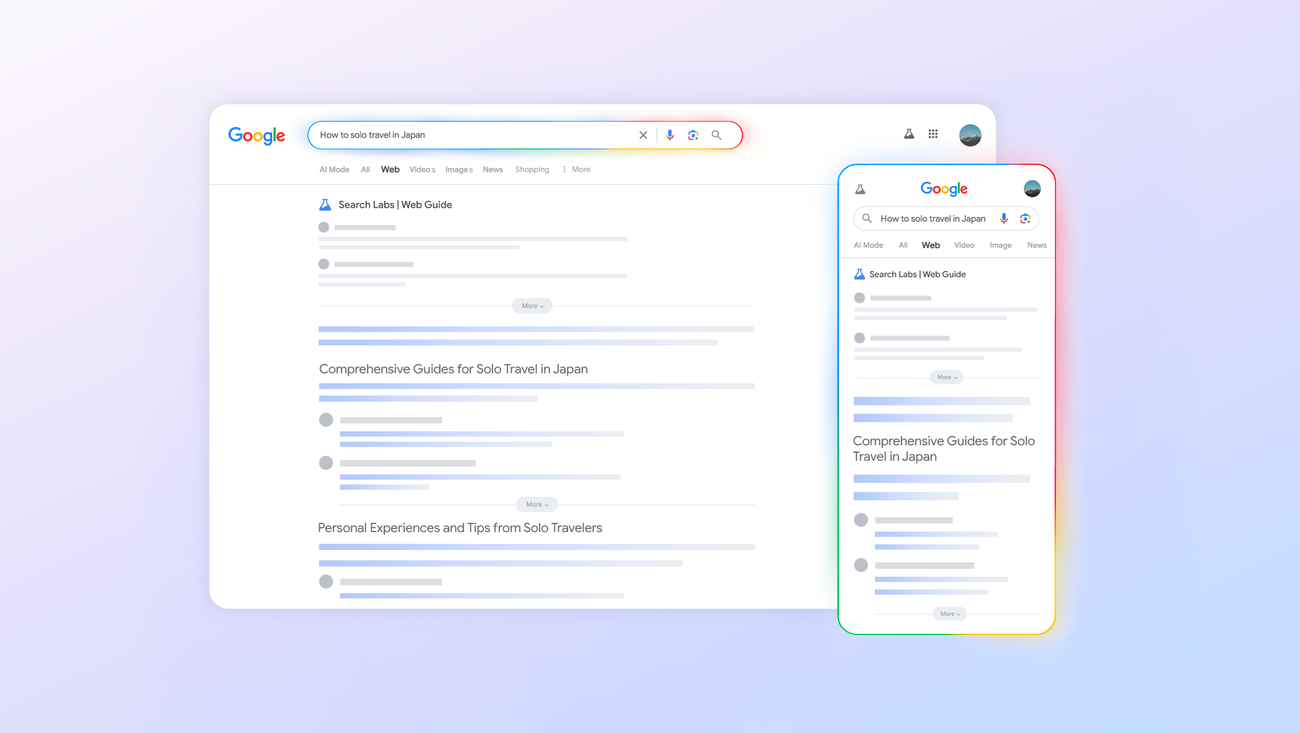
We’re launching Web Guide, a Search Labs experiment that uses AI to intelligently organize the search results page, making it easier to find information and web pages.

Web Guide groups web links in helpful ways — like pages related to specific aspects of your query. Under the hood, Web Guide uses a custom version of Gemini to better understand both a search query and content on the web, creating more powerful search capabilities that better surface web pages you may not have previously discovered. Similar to AI Mode, Web Guide uses a query fan-out technique, concurrently issuing multiple related searches to identify the most relevant results.

For example, try it for open-ended searches like “how to solo travel in Japan.” Or try detailed queries in multiple sentences like, “My family is spread across multiple time zones. What are the best tools for staying connected and maintaining close relationships despite the distance?”

Similar Posts

  • Razer Pro Click V2 Vertical Review: A Hybrid Gaming Mouse

    Switching to a vertical mouse is a hard sell. Having to change how you use a mouse completely can be an intimidating task, especially with how unnatural the new hand position feels at first—you’re going entirely against the muscle memory you’ve spent years building up.One of the largest challenges to the switch is the initial loss of pointer accuracy. If you’re in an office setting, you may find yourself wandering around a bit or struggling to move your new mouse as quickly as you did before. But in a slow-paced setting like that, all you struggle with is a few mis-clicks or slightly slower navigation. If you try to make this transition with gaming, it’s far more jarring, and the consequences are much more immediately noticeable.But even if it’s difficult to adapt to, could vertical mice be the future of gaming? Razer’s new Pro Click V2 Vertical Edition is a hybrid productivity and gaming vertical mouse. Vertical mice typically cater to office workers, but the focus on gaming performance makes the $120 Pro Click V2 one of a kind.Desk PresenceThe Pro Click V2 Vertical looks, more than anything else, like a modern gaming mouse. It has the textured exterior, metallic highlights, and slightly organic, H.R. Giger-esque curvature typical of Razer’s design language. But everything has been shifted around. The curved, cutting thumb rest sits on top of the mouse instead of on the side. A flare juts out from the right side as a place to rest the underside of your hand. The gunmetal highlight sits at the peak of the mouse rather than between the two buttons. Even the USB port is vertical, a humorous attention to detail.It’s intentionally designed as a gaming mouse that just happens to be vertical. Aesthetically, the only downside is the minimal RGB lighting. With only one section of lighting that runs along the bottom of the mouse, RGB lighting fans might feel disappointed. Still, it’s bright, reactive, and has great color accuracy. It’s more than enough for me, especially with how customizable it is with Razer’s Chroma software.The Pro Click V2 Vertical has the same specs as the standard Pro Click V2, with a 1,000-Hz polling rate, a 2.4-GHz dongle that can be stored on the underside, Bluetooth multi-device connectivity, and a reprogrammable button on top. The only features lost are the mouse wheel’s horizontal scrolling and toggleable non-ratcheted rotation.This mouse includes two major productivity features: app-specific profiles and multi-device connectivity, and both work effortlessly. Razer Synapse immediately detected different software and changed the active profile in response, and pressing the button on the underside of the mouse swapped between paired devices instantaneously.Beyond that, Razer Synapse is as impressive as always. I consistently find the software to be one of the best and most intuitive on the market, and that’s the case here. All of the menus are simple and efficient, the settings can be changed in real time, and the adjustments all have tooltips and explanations to tell you exactly what you’re changing.Annoyingly, Razer Synapse has advertisements on the homepage, something I’ve complained about when reviewing SteelSeries products in the past. However, unlike Steelseries GG, these “recommendations” can be permanently disabled in the app’s settings.Performance and PracticeThe overall hand position of the Pro Click V2 Vertical is natural, but incredibly upright. While some vertical mice, like those from Logitech or Hansker, find a middle ground between a standard and truly “vertical” hand position, Razer opted for a nearly perpendicular shape. While this is technically an ideal ergonomic shape, it will be harder to adapt if you’re moving directly from a standard mouse, and might not be as comfortable during the adjustment period.It felt unnatural for the first week or so, and required practice to use comfortably and confidently. Once I had acclimated, my speed and accuracy were nearly at the same level as a standard mouse, although consistent use still felt clunky and unfamiliar compared to the horizontal mice I’d been using for most of my life.

  • Gridcare thinks more than 100 GW of data center capacity is hiding in the grid

    Hyperscalers and data center developers are in a pickle: They all want to add computing power tomorrow, but utilities frequently play hard to get, citing years-long waits for grid connections.

    “All the AI data centers are struggling to get connected,” Amit Narayan, founder and CEO of Gridcare, told TechCrunch. “They’re so desperate. They are looking for solutions, which may or may not happen. Certainly not in the five-year timelines they cite.”

    That has led many data centers to pursue what’s called “behind the meter” power sources — basically, they build their own power plants, a costly endeavor that hints at just how desperate they are for electricity.

    But Narayan knew there was plenty of slack in the system, even if utilities themselves haven’t discovered it yet. He has studied the grid for the last 15 years, first as a Stanford researcher then as a founder of another company. “How do we create more capacity when everyone thinks that there is no capacity on the grid?” he said.

    Narayan said that Gridcare, which has been operating in stealth, has already discovered several places where extra capacity exists, and it’s ready to play matchmaker between data centers and utilities.

    Gridcare recently closed an oversubscribed $13.5 million seed round, the company told TechCrunch. The round was led by Xora, Temasek’s deep tech venture firm, with participation from Acclimate Ventures, Aina Climate AI Ventures, Breakthrough Energy Discovery, Clearvision, Clocktower Ventures, Overture Ventures, Sherpalo Ventures, and WovenEarth.

    For Narayan and his colleagues at Gridcare, the first step to finding untapped capacity was to map the existing grid. Then the company used generative AI to help forecast what changes might be implemented in the coming years. It also layers on other details, including the availability of fiber optic connections, natural gas, water, extreme weather, permitting, and community sentiment around data center construction and expansion. 

    Techcrunch event

    San Francisco
    |
    October 27-29, 2025

    “There are 200,000-plus scenarios that you have to consider every time you’re running this study,” Narayan said.

    To make sure it’s not running afoul of regulations, Gridcare then takes that data and weighs it against federal guidelines that dictate grid usage. Once it finds a spot, it starts talking with the relevant utility to verify the data.

    “We’ll find out where the maximum bang for the buck is,” Narayan said.

    At the same time, Gridcare works with hyperscalers and data center developers to identify where they are looking to expand operations or build new ones. “They have already told us what they’re willing to do. We know the parameters under which they can operate,” he said.

    That’s when the matchmaking begins.

    Gridcare sells its services to data center developers, charging them a fee based on how many megawatts of capacity the startup can unlock for them. “That fee is significant for us, but it’s negligible for data centers,” Narayan said.

    For some data centers, the price of admission might be forgoing grid power for a few hours here and there, relying on on-site backup power instead. For others, the path might be clearer if their demand helps green-light a new grid-scale battery installation nearby. In the future, the winner might be the developer that is willing to pay more. Utilities have already approached Gridcare inquiring about auctioning access to newfound capacity.

    Regardless of how it happens, Narayan thinks that Gridcare can unlock more than 100 gigawatts of capacity using its approach. “We don’t have to solve nuclear fusion to do this,” he said.

    Update: Corrected spare capacity on the grid to gigawatts from megawatts.
  • Best Noise-Canceling Headphones: Sony, Bose, Apple, and More

    Honorable MentionsNow that the majority of new headphones and earbuds offer at least a modicum of noise canceling, it’d be impossible (and unproductive) to list everything we like above. If you haven’t yet found your fit, here are more favorites worth considering.Beyerdynamic Amiron 300 for $280: These simple-looking earbuds (8/10, WIRED Recommends) are a great way to experience quiet luxury. They have 10 hours of battery life with noise canceling engaged, and they have some of the best-sounding drivers for vocals I’ve heard in any earbuds.Sony WF-1000XM5 earbuds for $298: Sony’s fifth-generation flagship earbuds (7/10, WIRED Recommends) slim down while stepping up. These buds are smaller and slicker (maybe too slick when it comes to grabbing them) than the previous XM4 buds. As before, they provide great sound and noise canceling that outduels plenty of options, with a cost to match. In true Sony style, they serve up a truckload of adaptive features and EQ controls while retaining a solid eight hours of playback time per charge with ANC and 12 hours without it. —Ryan WaniataSoundcore Life Q30 for $60-85: Anker’s Soundcore line is nothing if not value-conscious, and the Life Q30 provide an embarrassing list of extras for their bargain-basement pricing. You’ll get clear and warm sound, great features, tons of battery life, and noise canceling that gets the job done even on a long flight, though it can’t keep up with flagship pairs. It’s hard to complain when they cost hundreds less, especially with sale pricing that sometimes drops to around $50.Sony WH-1000XM4 for $250-350: Sony’s WH-1000X lineup has produced some of the best noise-canceling headphones for nearly a decade, and the aging WH-1000XM4 (9/10, WIRED Recommends) are no exception. They periodically go on sale for under $300, but it’s getting harder to find them below full price, which is tough for a five-year-old model.Bowers & Wilkins Pi8 Earbuds for $400: Bowers & Wilkins’ Pi8 (8/10, WIRED Recommends) offer a sleek, comfortable design, solid (albeit not Bose-beating) noise canceling, and great sound. Call quality is also excellent, which makes these perhaps the perfect business-class earbuds, though their hefty price won’t appeal to everyone.Bowers and Wilkins PX7 S2e for $400: The Px7 S2e feature upgraded audio quality for fantastic sound in stylish and sophisticated design. They’re also among the most comfortable headphones we’ve tested, but their noise canceling doesn’t rise to the level of the top players for the money.Beyerdynamic Aventho 300 for $400: These over-ears from Beyerdynamic (7/10, WIRED Recommends) have the brand’s classic studio sound, with a tight crisp high range and punchy lows. The downside is that they don’t cancel noise quite as well as models from Sony, Bose, and others above. Still, they sound great and are worth considering, especially if you can snag them on sale.Soundcore Space A40 for $60: Another top value buy from Anker’s Soundcore brand, the Space A40 (8/10, WIRED Recommends) are some of our favorite cheap earbuds, especially as their price continues to fall. You’ll find a classy design, lots of features, quality sound, and great noise canceling for their class.Apple Beats Fit Pro for $199: The Beats Fit Pro are an aging but still knockout pair of wireless buds, with great sound, easy-access physical buttons, and solid noise canceling to boot. Add to that six hours of battery life, spatial audio compatibility with Apple Music and other services, and you’ve got one of the best pairs of earbuds ever “designed in California.”Epos/Sennheiser Adapt 660 for $210: Want excellent sound, a comfortable fit, and high-quality noise-canceling tech for less than what you’d pay for Sony or Bose headphones? Check out this collaboration between Epos and Sennheiser. The Epos/Sennheiser Adapt 660 (8/10, WIRED Recommends) sound fantastic and are some of the lightest noise-canceling headphones I’ve ever worn. They also feature excellent microphones for great silence on calls and Zooms.

Leave a Reply

Your email address will not be published. Required fields are marked *