Web Guide: An experimental AI-organized search results page

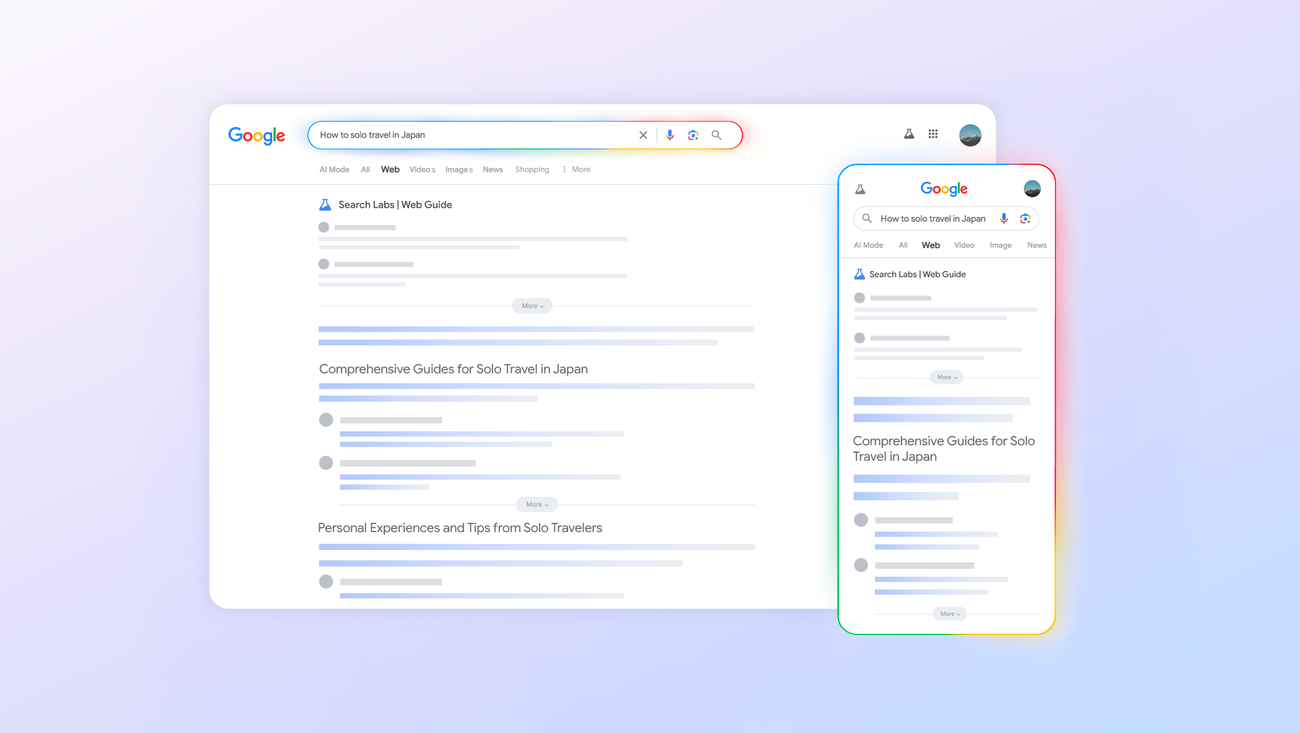
We’re launching Web Guide, a Search Labs experiment that uses AI to intelligently organize the search results page, making it easier to find information and web pages.

Web Guide groups web links in helpful ways — like pages related to specific aspects of your query. Under the hood, Web Guide uses a custom version of Gemini to better understand both a search query and content on the web, creating more powerful search capabilities that better surface web pages you may not have previously discovered. Similar to AI Mode, Web Guide uses a query fan-out technique, concurrently issuing multiple related searches to identify the most relevant results.

For example, try it for open-ended searches like “how to solo travel in Japan.” Or try detailed queries in multiple sentences like, “My family is spread across multiple time zones. What are the best tools for staying connected and maintaining close relationships despite the distance?”

Similar Posts

  • Obvio’s stop sign cameras use AI to root out unsafe drivers

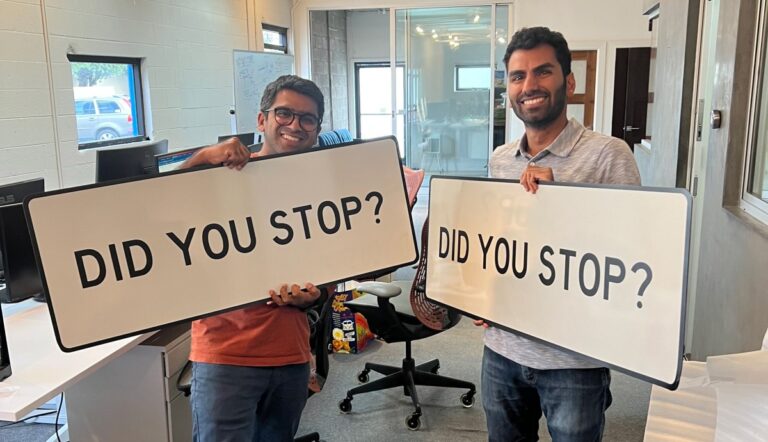
    American streets are incredibly dangerous for pedestrians. A San Carlos, California-based startup called Obvio thinks it can change that by installing cameras at stop signs — a solution the founders also say won’t create a panopticon. 

    That’s a bold claim at a time when other companies like Flock have been criticized for how its license plate-reading cameras have become a crucial tool in an overreaching surveillance state. 

    Obvio founders Ali Rehan and Dhruv Maheshwari believe they can build a big enough business without indulging those worst impulses. They’ve designed the product with surveillance and data-sharing limitations to ensure they can follow through with that claim.

    They’ve found deep pockets willing to believe them, too. The company has just completed a $22 million Series A funding round led by Bain Capital Ventures. Obvio plans to use those funds to expand beyond the first five cities where it’s currently operating in Maryland. 

    Rehan and Maheshwari met while working at Motive, a company that makes dashboard cameras for the trucking industry. While there, Maheshwari told TechCrunch the pair realized “a lot of other normal passenger vehicles are awful drivers.” 

    The founders said they were stunned the more they looked into road safety. Not only were streets and crosswalks getting more dangerous for pedestrians, but in their eyes, the U.S. was also falling behind on enforcement. 

    [embedded content]

    “Most other countries are actually pretty good at this,” Maheshwari said. “They have speed camera technology. They have a good culture of driving safety. The U.S. is actually one of the worst across all the modern nations.”

    Maheshwari and Rehan began studying up on road safety by reading books and attending conferences. They found that people in the industry gravitated toward three general solutions: education, engineering, and enforcement. 

    In their eyes, those approaches were often too separated from each other. It’s hard to quantify the impact of educational efforts. Local officials may try to fix a problematic intersection by, say, installing a roundabout, but that can take years of work and millions of dollars. And law enforcement can’t camp out at every stop sign.

    Rehan and Maheshwari saw promise in combining them. 

    The result is a pylon (often brightly-colored) topped with a solar-powered camera that can be installed near almost any intersection. It’s designed not to blend in — part of the education and awareness aspect — and it’s also carefully engineered to be cheap and easy to install.

    The on-device AI is trained to spot the worst types of stop sign or other infractions. (The company also claims on its website it can catch speeding, crosswalk violations, illegal turns, unsafe lane changes, and even distracted driving.) When one of these things happen, the system matches a car’s license plate to the state’s DMV database. 

    All of that information — the accuracy of the violation, the license plate — is verified by either Obvio staff or contractors before it’s sent to law enforcement, which then has to review the infractions before issuing a citation.

    Obvio gives the tech to municipalities for free and makes money from the citations. Exactly how that citation revenue will get split between Obvio and the governments will vary from place to place, as Maheshwari said regulations about such agreements differ by state.

    That clearly creates an incentive for increasing the number of citations. But Rehan and Maheshwari said they can build a business around stopping the worst offenses across a wide swath of American cities. They also said they want Obvio to remain present in — and responsive to — the communities that use their tech.

    “Automated enforcement should be used in conjunction with community advocacy and community support, it shouldn’t be this camera that you put up that does revenue grab[s] and gotchas,” Maheshwari said. The goal is to “start using these cameras in a way to warn and deter the most egregious drivers [so] you can actually create communitywide support and behavior change.”

    Cities and their citizens “need to trust us,” Maheshwari said. 

    There’s also a technological explanation for why Obvio’s cameras may not become an overpowered surveillance tool for law enforcement beyond their intended use.

    Obvio’s camera pylon records and processes its footage locally. It’s only when a violation is spotted that the footage leaves the device. Otherwise, all other footage of vehicles and pedestrians passing through a given intersection stays on the device for about 12 hours before it gets deleted. (The footage is also technically owned by the municipalities, which have remote access.)

    This doesn’t eliminate the chance that law enforcement will use the footage to surveil citizens in other ways. But it does reduce that chance.

    That focus is what drove Bain Capital Ventures partner Ajay Agarwal to invest in Obvio.

    “Yes, in the short term, you can maximize profits, and erode those values, but I think over time, it will limit the ability of this company to be ubiquitous. It’ll create enemies or create people who don’t want this,” he told TechCrunch. “Great founders are willing to sacrifice entire lines of business, frankly, and lots of revenue, in pursuit of the ultimate mission.”

  • Try on styles with AI, jump on great prices and more

    Whether you’re still on the hunt for the perfect summer maxi skirt, dreaming about a new fall jacket or starting your back to school shopping, our shopping tools can help you explore your personal style and get a good price. Here are a few ways you can use Google’s latest shopping features:Try clothes on, virtuallyAt I/O in May, we introduced our try on tool as a limited experiment in Search Labs, allowing shoppers to upload a photo of themselves and use AI to virtually try on clothes. Today, try on is launching in the U.S., letting you easily try on styles from the billions of apparel items in our Shopping Graph across Search, Google Shopping and even product results on Google Images.

  • America’s AI watchdog is losing its bite

    Most Americans encounter the Federal Trade Commission only if they’ve been scammed: It handles identity theft, fraud, and stolen data. During the Biden administration, the agency went after AI companies for scamming customers with deceptive advertising or harming people by selling irresponsible technologies. With yesterday’s announcement of President Trump’s AI Action Plan, that era may now be over.  In the final months of the Biden administration under chair Lina Khan, the FTC levied a series of high-profile fines and actions against AI companies for overhyping their technology and bending the truth—or in some cases making claims that were entirely false. It found that the security giant Evolv lied about the accuracy of its AI-powered security checkpoints, which are used in stadiums and schools but failed to catch a seven-inch knife that was ultimately used to stab a student. It went after the facial recognition company Intellivision, saying the company made unfounded claims that its tools operated without gender or racial bias. It fined startups promising bogus “AI lawyer” services and one that sold fake product reviews generated with AI. These actions did not result in fines that crippled the companies, but they did stop them from making false statements and offered customers ways to recover their money or get out of contracts. In each case, the FTC found, everyday people had been harmed by AI companies that let their technologies run amok.
    The plan released by the Trump administration yesterday suggests it believes these actions went too far. In a section about removing “red tape and onerous regulation,” the White House says it will review all FTC actions taken under the Biden administration “to ensure that they do not advance theories of liability that unduly burden AI innovation.” In the same section, the White House says it will withhold AI-related federal funding from states with “burdensome” regulations. This move by the Trump administration is the latest in its evolving attack on the agency, which provides a significant route of redress for people harmed by AI in the US. It’s likely to result in faster deployment of AI with fewer checks on accuracy, fairness, or consumer harm.
    Under Khan, a Biden appointee, the FTC found fans in unexpected places. Progressives called for it to break up monopolistic behavior in Big Tech, but some in Trump’s orbit, including Vice President JD Vance, also supported Khan in her fights against tech elites, albeit for the different goal of ending their supposed censorship of conservative speech.  But in January, with Khan out and Trump back in the White House, this dynamic all but collapsed. Trump released an executive order in February promising to “rein in” independent agencies like the FTC that wage influence without consulting the president. The next month, he started taking that vow to—and past—its legal limits. In March, he fired the only two Democratic commissioners at the FTC. On July 17 a federal court ruled that one of those firings, of commissioner Rebecca Slaughter, was illegal given the independence of the agency, which restored Slaughter to her position (the other fired commissioner, Alvaro Bedoya, opted to resign rather than battle the dismissal in court, so his case was dismissed). Slaughter now serves as the sole Democrat. In naming the FTC in its action plan, the White House now goes a step further, painting the agency’s actions as a major obstacle to US victory in the “arms race” to develop better AI more quickly than China. It promises not just to change the agency’s tack moving forward, but to review and perhaps even repeal AI-related sanctions it has imposed in the past four years. How might this play out? Leah Frazier, who worked at the FTC for 17 years before leaving in May and served as an advisor to Khan, says it’s helpful to think about the agency’s actions against AI companies as falling into two areas, each with very different levels of support across political lines.  The first is about cases of deception, where AI companies mislead consumers. Consider the case of Evolv, or a recent case announced in April where the FTC alleges that a company called Workado, which offers a tool to detect whether something was written with AI, doesn’t have the evidence to back up its claims. Deception cases enjoyed fairly bipartisan support during her tenure, Frazier says. “Then there are cases about responsible use of AI, and those did not seem to enjoy too much popular support,” adds Frazier, who now directs the Digital Justice Initiative at the Lawyers’ Committee for Civil Rights Under Law. These cases don’t allege deception; rather, they charge that companies have deployed AI in a way that harms people. The most serious of these, which resulted in perhaps the most significant AI-related action ever taken by the FTC and was investigated by Frazier, was announced in 2023. The FTC banned Rite Aid from using AI facial recognition in its stores after it found the technology falsely flagged people, particularly women and people of color, as shoplifters. “Acting on false positive alerts,” the FTC wrote, Rite Aid’s employees “followed consumers around its stores, searched them, ordered them to leave, [and] called the police to confront or remove consumers.”

    The FTC found that Rite Aid failed to protect people from these mistakes, did not monitor or test the technology, and did not properly train employees on how to use it. The company was banned from using facial recognition for five years.  This was a big deal. This action went beyond fact-checking the deceptive promises made by AI companies to make Rite Aid liable for how its AI technology harmed consumers. These types of responsible-AI cases are the ones Frazier imagines might disappear in the new FTC, particularly if they involve testing AI models for bias. “There will be fewer, if any, enforcement actions about how companies are deploying AI,” she says. The White House’s broader philosophy toward AI, referred to in the plan, is a “try first” approach that attempts to propel faster AI adoption everywhere from the Pentagon to doctor’s offices. The lack of FTC enforcement that is likely to ensue, Frazier says, “is dangerous for the public.”

  • Our first long-duration energy storage partnership

    Electricity powers modern life. And we’re accelerating a wide range of technologies, from enhanced geothermal to advanced nuclear to even fusion technologies, that can enable a future where on-demand electricity needs are met with clean energy, every hour of every day.Today, we’re adding another technology to our portfolio: long duration energy storage (LDES). Through a new long-term partnership with Energy Dome, we plan to support multiple commercial projects globally to deploy their LDES technology.Energy Dome’s novel CO₂ Battery can store excess clean energy and then dispatch it back to the grid for 8-24 hours, bridging the gap between when renewable energy is generated and when it is needed. With this commercial partnership, as well as an investment in the company, we believe these projects can unlock new clean energy for grids where we operate before 2030, helping meet near-term electricity system needs and moving us closer to our 24/7 carbon-free energy goal.By bringing this first-of-a-kind LDES technology to market faster, we aim to rapidly bring its potential to communities everywhere — making reliable, affordable electricity available around the clock and supporting the resilience of grids as they integrate growing amounts of renewable energy sources.Why it’s importantLithium-ion batteries, which typically store and dispatch power for 4 hours or less, have been critical for adding electricity capacity to grids and managing short-term fluctuations in renewable generation — when the sun isn’t shining or the wind isn’t blowing. Google’s support for these shorter-duration batteries has helped the grids we rely on, from Belgium to Nevada, meet peak electricity demand and reduce the need to ramp up fossil fuel power plants.But what if we could store and dispatch clean energy for more than a few hours, or even a full day? Studies by the Electric Power Research Institute show that LDES technologies can cost-effectively integrate a growing volume of renewables onto power systems and contribute to more flexible, reliable grids. The LDES Council estimates that deploying up to 8 terawatts (TW) of LDES by 2040 could result in $540 billion in annual savings globally, thanks in part to their ability to optimize grids.How the technology worksEnergy Dome’s novel approach to energy storage uses carbon dioxide (CO₂) held in a unique dome-shaped battery. When there’s an abundance of renewable energy on the grid, the system uses that power to compress CO₂ gas into a liquid. When the grid needs more clean power, the liquid CO₂ expands back into a hot gas under pressure, creating a powerful force — much like steam escaping a pressure cooker — which spins a turbine. This spinning turbine generates carbon-free energy that can flow directly back into the grid for durations ranging from 8 to 24 hours.Energy Dome has already signed contracts to build commercial scale projects in Italy, the U.S., and India. And their technology has already proven successful, having injected electrons into the Italian grid for more than three years, thanks to their commercial demonstration facility and now with their full-scale 20 megawatt (MW) commercial plant in Sardinia, Italy.Why scale is crucialLDES has the potential to commercialize much faster than some of the other advanced clean energy technologies in our portfolio. This means we can use it in the near term to help the electricity system grow more flexibly and reliably, alongside other tools we’re developing such as data center demand response.By supporting multiple commercial deployments of Energy Dome’s technology globally, we aim to bring this technology to scale faster and at lower costs. Beyond our long-term collaboration with Energy Dome, we plan to support a growing range of LDES technologies under development through both commercial agreements that can catalyze wider market adoption of more mature technologies, like Energy Dome’s, as well as earlier-stage investments.To remove barriers to the deployment and commercialization of LDES and other advanced carbon-free energy technologies, we’re also advocating for clean energy policies, ensuring that energy markets fully value firm, flexible carbon-free technologies, and advancing policy measures that enable infrastructure essential for grid decarbonization and energy security.We’re excited to take this first step with Energy Dome to unlock the full potential of LDES. Our partnership will strengthen grid resilience while enabling us to power our technologies, grow our economies and keep the lights on in our homes with 24/7 clean energy.

Leave a Reply

Your email address will not be published. Required fields are marked *