Online MAGA cope is now Congressional strategy

Right-wing influencers try blaming Democrats for hiding the Epstein files — and DC Republicans follow suit.

Right-wing influencers try blaming Democrats for hiding the Epstein files — and DC Republicans follow suit.

President Trump Hosts A Reception For GOP Members Of Congress
Tina Nguyen
Tina Nguyen is a senior reporter for The Verge, covering the Trump administration, Elon Musk’s takeover of the federal government, and the tech industry’s embrace of the MAGA movement.

When it comes to defending Donald Trump from the worst accusations, the MAGA influencer-industrial complex, whether out of loyalty or self-preservation, often defaults to whataboutism, arguing that the Democrats are just as guilty as Trump, or (ideally) worse. This principle has held true with the current Jeffrey Epstein saga, and as their audience’s anger against the Trump administration skyrockets, the MAGA influencer world is trying a new tack: blame the Democrats, not Trump, for keeping the “Epstein Files” under lock and key.

Trump, the person who could feasibly order the release of said documents, has spent the past few weeks trying to smother the drama from a few different angles, ultimately only fanning flames every time he attempted to deemphasize Epstein. He tried dismissing it during a Cabinet meeting (“Are you still talking about Jeffrey Epstein?”), downplaying it on Truth Social (“Let’s … not waste Time and Energy on Jeffrey Epstein, somebody that nobody cares about”), and criticizing a reporter for asking about Epstein (“Are people still talking about this guy?”).

But there’s no indication that the MAGA-influencer complex will ever stop talking about Epstein, or that their audiences will ever let it go. But over the past week, the influencer class, and subsequently the GOP, has started to maneuver Trump’s spin into a more acceptable talking point, inspired by a recent Wall Street Journal bombshell reporting that the Justice Department had told Trump back in May that his name was in the pile of documents related to Jeffrey Epstein. “Of course there’s going to be mentions of Epstein, who was a member of Mar-a-Lago until Trump kicked him out” over a decade ago, said Alex Jones, the Infowars host who’d spent the past several days raging about the Epstein Files. But while he had been calling for the head of anyone in the administration for failing to deliver, it was much easier to circle the wagon around Trump the moment that a mainstream publication tied him to bad behavior.

Laura Loomer, another prominent influencer who’d been criticizing the administration for its underwhelming response, also took the opportunity to try coming home by questioning where exactly Trump’s name appeared in the files, while also glazing Trump. “Are they trying to say that a file is somebody’s name in an address book?” she rhetorically asked Politico Playbook on Thursday, adding that she, too, had a large address book. “Some of those people in my address book have committed crimes. Does that mean I’m implicated in their crimes? President Trump is not a pedophile. And I look forward to seeing him sue every journalist and publication that is trying to imply that he is one.”

In the days and weeks since the Trump administration released their brief memo about the Epstein files, the MAGA influencer world — specifically, those who built their careers “just asking questions” about Epstein while also cozying up to Trump — has grappled with a difficult choice: either cater to their audience’s demand to keep asking what the elites are hiding about Epstein, or maintain their relationship and standing with the White House.

Some have chosen their audiences, gambling that their following is loyal beyond Trump, and that their influence isn’t contingent on their White House access. (Tucker Carlson, for instance, published a two-hour episode that was entirely focused on the Epstein conspiracies — one week after he implied that Epstein was a Mossad agent.) Others have completely flipped back to Trump, such as the influencer Catturd, an onetime Epstein truther who began implying that “the podcast bro ‘influencers’” now criticizing Trump may have taken Russian money to do so. (In 2024, US prosecutors indicted two employees of RT for illegally funneling money to spread Kremlin propaganda, alleging that they had put $10 million into a Tennessee-based media company whose description matched up with Tenet Media, which worked with Tim Pool, Benny Johnson, and others.) Catturd then tweeted that he was “never abandoning Trump”, and spent the subsequent week calling for Barack Obama’s indictment and posting memes of press secretary Karoline Leavitt.

But for everyone else, it’s been difficult to have it both ways. Loomer’s attempt to pin the blame on Attorney General Pam Bondi, for instance, failed when Trump refused to fire Bondi, while influencers who attempted to convince their audience to move onto different topics saw their audience revolt (particularly if those influencers, such as Benny Johnson, cited their conversations with government officials as reason enough).

And before you dismiss it as sturm-and-drang on the internet, the very same dynamic can be seen in Congress, where the Republicans are trying their best to satisfy the base while appeasing the President — a task made difficult because their normal, everyday constituents also hold deep suspicions about the entire Epstein matter. A Reuters/Ipsos poll released last week found that the vast majority of voters — including a majority of Republicans — believe that the government is hiding information about the infamous “client list”. And tellingly, only 35 percent of Republicans believed that the Trump administration was handling it well. (30 percent said Trump was not, and 35 percent were unsure.)

On Wednesday, a House Oversight subcommittee voted to subpoena the Department of Justice for the Epstein Files, with a majority composed of five Democrats and three Republicans. The two Republicans who opposed the subpoena ended up tacking on other requests for Epstein-related communications from Biden officials and the DOJ. Per ABC News, the “officials” included the Democratic subjects of MAGA’s most enduring conspiracy theories: “Bill and Hillary Clinton, James Comey, Loretta Lynch, Eric Holder, Merrick Garland, Robert Mueller, William Barr, Jeff Sessions and Alberto Gonzales.”

In other words, no one seems to be able to run with Trump’s assessment that Epstein is “somebody that nobody cares about.” Unable to quell the belief that there’s a conspiracy afoot, the only thing to do is try to implicate Democrats. Even Speaker Mike Johnson, who abruptly called a five-week recess last Thursday to prevent his Democratic counterparts from voting to release the Epstein files, leaned in on a potential conspiracy. “One of our concerns is, of course, that it was held in the hands of the DOJ leaders under the last administration, the Biden-Harris administration,” he told a Newsmax reporter on Wednesday. “And we all know how crooked and corrupt so many of those officials were, how they engaged in lawfare against President Trump. He has a concern, and I do as well, that things could have been doctored in those records.” When it comes to right-wing talking points based on sordid, unproven allegations, it’s best to start winking early — and in sync with the president, too.


Follow topics and authors from this story to see more like this in your personalized homepage feed and to receive email updates.

Most Popular

Similar Posts

  • Obvio’s stop sign cameras use AI to root out unsafe drivers

    American streets are incredibly dangerous for pedestrians. A San Carlos, California-based startup called Obvio thinks it can change that by installing cameras at stop signs — a solution the founders also say won’t create a panopticon. 

    That’s a bold claim at a time when other companies like Flock have been criticized for how its license plate-reading cameras have become a crucial tool in an overreaching surveillance state. 

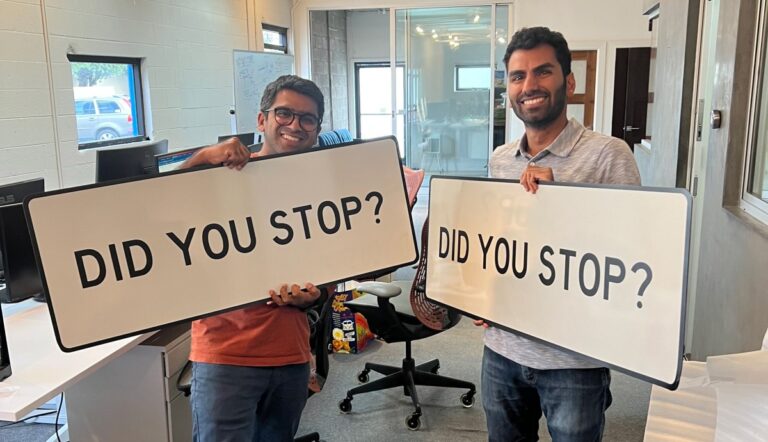
    Obvio founders Ali Rehan and Dhruv Maheshwari believe they can build a big enough business without indulging those worst impulses. They’ve designed the product with surveillance and data-sharing limitations to ensure they can follow through with that claim.

    They’ve found deep pockets willing to believe them, too. The company has just completed a $22 million Series A funding round led by Bain Capital Ventures. Obvio plans to use those funds to expand beyond the first five cities where it’s currently operating in Maryland. 

    Rehan and Maheshwari met while working at Motive, a company that makes dashboard cameras for the trucking industry. While there, Maheshwari told TechCrunch the pair realized “a lot of other normal passenger vehicles are awful drivers.” 

    The founders said they were stunned the more they looked into road safety. Not only were streets and crosswalks getting more dangerous for pedestrians, but in their eyes, the U.S. was also falling behind on enforcement. 

    [embedded content]

    “Most other countries are actually pretty good at this,” Maheshwari said. “They have speed camera technology. They have a good culture of driving safety. The U.S. is actually one of the worst across all the modern nations.”

    Maheshwari and Rehan began studying up on road safety by reading books and attending conferences. They found that people in the industry gravitated toward three general solutions: education, engineering, and enforcement. 

    In their eyes, those approaches were often too separated from each other. It’s hard to quantify the impact of educational efforts. Local officials may try to fix a problematic intersection by, say, installing a roundabout, but that can take years of work and millions of dollars. And law enforcement can’t camp out at every stop sign.

    Rehan and Maheshwari saw promise in combining them. 

    The result is a pylon (often brightly-colored) topped with a solar-powered camera that can be installed near almost any intersection. It’s designed not to blend in — part of the education and awareness aspect — and it’s also carefully engineered to be cheap and easy to install.

    The on-device AI is trained to spot the worst types of stop sign or other infractions. (The company also claims on its website it can catch speeding, crosswalk violations, illegal turns, unsafe lane changes, and even distracted driving.) When one of these things happen, the system matches a car’s license plate to the state’s DMV database. 

    All of that information — the accuracy of the violation, the license plate — is verified by either Obvio staff or contractors before it’s sent to law enforcement, which then has to review the infractions before issuing a citation.

    Obvio gives the tech to municipalities for free and makes money from the citations. Exactly how that citation revenue will get split between Obvio and the governments will vary from place to place, as Maheshwari said regulations about such agreements differ by state.

    That clearly creates an incentive for increasing the number of citations. But Rehan and Maheshwari said they can build a business around stopping the worst offenses across a wide swath of American cities. They also said they want Obvio to remain present in — and responsive to — the communities that use their tech.

    “Automated enforcement should be used in conjunction with community advocacy and community support, it shouldn’t be this camera that you put up that does revenue grab[s] and gotchas,” Maheshwari said. The goal is to “start using these cameras in a way to warn and deter the most egregious drivers [so] you can actually create communitywide support and behavior change.”

    Cities and their citizens “need to trust us,” Maheshwari said. 

    There’s also a technological explanation for why Obvio’s cameras may not become an overpowered surveillance tool for law enforcement beyond their intended use.

    Obvio’s camera pylon records and processes its footage locally. It’s only when a violation is spotted that the footage leaves the device. Otherwise, all other footage of vehicles and pedestrians passing through a given intersection stays on the device for about 12 hours before it gets deleted. (The footage is also technically owned by the municipalities, which have remote access.)

    This doesn’t eliminate the chance that law enforcement will use the footage to surveil citizens in other ways. But it does reduce that chance.

    That focus is what drove Bain Capital Ventures partner Ajay Agarwal to invest in Obvio.

    “Yes, in the short term, you can maximize profits, and erode those values, but I think over time, it will limit the ability of this company to be ubiquitous. It’ll create enemies or create people who don’t want this,” he told TechCrunch. “Great founders are willing to sacrifice entire lines of business, frankly, and lots of revenue, in pursuit of the ultimate mission.”

  • Gridcare thinks more than 100 GW of data center capacity is hiding in the grid

    Hyperscalers and data center developers are in a pickle: They all want to add computing power tomorrow, but utilities frequently play hard to get, citing years-long waits for grid connections.

    “All the AI data centers are struggling to get connected,” Amit Narayan, founder and CEO of Gridcare, told TechCrunch. “They’re so desperate. They are looking for solutions, which may or may not happen. Certainly not in the five-year timelines they cite.”

    That has led many data centers to pursue what’s called “behind the meter” power sources — basically, they build their own power plants, a costly endeavor that hints at just how desperate they are for electricity.

    But Narayan knew there was plenty of slack in the system, even if utilities themselves haven’t discovered it yet. He has studied the grid for the last 15 years, first as a Stanford researcher then as a founder of another company. “How do we create more capacity when everyone thinks that there is no capacity on the grid?” he said.

    Narayan said that Gridcare, which has been operating in stealth, has already discovered several places where extra capacity exists, and it’s ready to play matchmaker between data centers and utilities.

    Gridcare recently closed an oversubscribed $13.5 million seed round, the company told TechCrunch. The round was led by Xora, Temasek’s deep tech venture firm, with participation from Acclimate Ventures, Aina Climate AI Ventures, Breakthrough Energy Discovery, Clearvision, Clocktower Ventures, Overture Ventures, Sherpalo Ventures, and WovenEarth.

    For Narayan and his colleagues at Gridcare, the first step to finding untapped capacity was to map the existing grid. Then the company used generative AI to help forecast what changes might be implemented in the coming years. It also layers on other details, including the availability of fiber optic connections, natural gas, water, extreme weather, permitting, and community sentiment around data center construction and expansion. 

    Techcrunch event

    San Francisco
    |
    October 27-29, 2025

    “There are 200,000-plus scenarios that you have to consider every time you’re running this study,” Narayan said.

    To make sure it’s not running afoul of regulations, Gridcare then takes that data and weighs it against federal guidelines that dictate grid usage. Once it finds a spot, it starts talking with the relevant utility to verify the data.

    “We’ll find out where the maximum bang for the buck is,” Narayan said.

    At the same time, Gridcare works with hyperscalers and data center developers to identify where they are looking to expand operations or build new ones. “They have already told us what they’re willing to do. We know the parameters under which they can operate,” he said.

    That’s when the matchmaking begins.

    Gridcare sells its services to data center developers, charging them a fee based on how many megawatts of capacity the startup can unlock for them. “That fee is significant for us, but it’s negligible for data centers,” Narayan said.

    For some data centers, the price of admission might be forgoing grid power for a few hours here and there, relying on on-site backup power instead. For others, the path might be clearer if their demand helps green-light a new grid-scale battery installation nearby. In the future, the winner might be the developer that is willing to pay more. Utilities have already approached Gridcare inquiring about auctioning access to newfound capacity.

    Regardless of how it happens, Narayan thinks that Gridcare can unlock more than 100 gigawatts of capacity using its approach. “We don’t have to solve nuclear fusion to do this,” he said.

    Update: Corrected spare capacity on the grid to gigawatts from megawatts.

  • Web Guide: An experimental AI-organized search results page

    We’re launching Web Guide, a Search Labs experiment that uses AI to intelligently organize the search results page, making it easier to find information and web pages.Web Guide groups web links in helpful ways — like pages related to specific aspects of your query. Under the hood, Web Guide uses a custom version of Gemini to better understand both a search query and content on the web, creating more powerful search capabilities that better surface web pages you may not have previously discovered. Similar to AI Mode, Web Guide uses a query fan-out technique, concurrently issuing multiple related searches to identify the most relevant results.For example, try it for open-ended searches like “how to solo travel in Japan.” Or try detailed queries in multiple sentences like, “My family is spread across multiple time zones. What are the best tools for staying connected and maintaining close relationships despite the distance?”

  • The hidden scaling cliff that’s about to break your agent rollouts

    Join the event trusted by enterprise leaders for nearly two decades. VB Transform brings together the people building real enterprise AI strategy. Learn more Enterprises that want to build and scale agents also need to embrace another reality: agents aren’t built like other software.  Agents are “categorically different” in how they’re built, how they operate, and…

  • Best Noise-Canceling Headphones: Sony, Bose, Apple, and More

    Honorable MentionsNow that the majority of new headphones and earbuds offer at least a modicum of noise canceling, it’d be impossible (and unproductive) to list everything we like above. If you haven’t yet found your fit, here are more favorites worth considering.Beyerdynamic Amiron 300 for $280: These simple-looking earbuds (8/10, WIRED Recommends) are a great way to experience quiet luxury. They have 10 hours of battery life with noise canceling engaged, and they have some of the best-sounding drivers for vocals I’ve heard in any earbuds.Sony WF-1000XM5 earbuds for $298: Sony’s fifth-generation flagship earbuds (7/10, WIRED Recommends) slim down while stepping up. These buds are smaller and slicker (maybe too slick when it comes to grabbing them) than the previous XM4 buds. As before, they provide great sound and noise canceling that outduels plenty of options, with a cost to match. In true Sony style, they serve up a truckload of adaptive features and EQ controls while retaining a solid eight hours of playback time per charge with ANC and 12 hours without it. —Ryan WaniataSoundcore Life Q30 for $60-85: Anker’s Soundcore line is nothing if not value-conscious, and the Life Q30 provide an embarrassing list of extras for their bargain-basement pricing. You’ll get clear and warm sound, great features, tons of battery life, and noise canceling that gets the job done even on a long flight, though it can’t keep up with flagship pairs. It’s hard to complain when they cost hundreds less, especially with sale pricing that sometimes drops to around $50.Sony WH-1000XM4 for $250-350: Sony’s WH-1000X lineup has produced some of the best noise-canceling headphones for nearly a decade, and the aging WH-1000XM4 (9/10, WIRED Recommends) are no exception. They periodically go on sale for under $300, but it’s getting harder to find them below full price, which is tough for a five-year-old model.Bowers & Wilkins Pi8 Earbuds for $400: Bowers & Wilkins’ Pi8 (8/10, WIRED Recommends) offer a sleek, comfortable design, solid (albeit not Bose-beating) noise canceling, and great sound. Call quality is also excellent, which makes these perhaps the perfect business-class earbuds, though their hefty price won’t appeal to everyone.Bowers and Wilkins PX7 S2e for $400: The Px7 S2e feature upgraded audio quality for fantastic sound in stylish and sophisticated design. They’re also among the most comfortable headphones we’ve tested, but their noise canceling doesn’t rise to the level of the top players for the money.Beyerdynamic Aventho 300 for $400: These over-ears from Beyerdynamic (7/10, WIRED Recommends) have the brand’s classic studio sound, with a tight crisp high range and punchy lows. The downside is that they don’t cancel noise quite as well as models from Sony, Bose, and others above. Still, they sound great and are worth considering, especially if you can snag them on sale.Soundcore Space A40 for $60: Another top value buy from Anker’s Soundcore brand, the Space A40 (8/10, WIRED Recommends) are some of our favorite cheap earbuds, especially as their price continues to fall. You’ll find a classy design, lots of features, quality sound, and great noise canceling for their class.Apple Beats Fit Pro for $199: The Beats Fit Pro are an aging but still knockout pair of wireless buds, with great sound, easy-access physical buttons, and solid noise canceling to boot. Add to that six hours of battery life, spatial audio compatibility with Apple Music and other services, and you’ve got one of the best pairs of earbuds ever “designed in California.”Epos/Sennheiser Adapt 660 for $210: Want excellent sound, a comfortable fit, and high-quality noise-canceling tech for less than what you’d pay for Sony or Bose headphones? Check out this collaboration between Epos and Sennheiser. The Epos/Sennheiser Adapt 660 (8/10, WIRED Recommends) sound fantastic and are some of the lightest noise-canceling headphones I’ve ever worn. They also feature excellent microphones for great silence on calls and Zooms.

Leave a Reply

Your email address will not be published. Required fields are marked *