The Drifter is a good old-fashioned thriller

It’s a point-and-click adventure that tells a twisting mystery.

It’s a point-and-click adventure that tells a twisting mystery.

ss_4b1247bafd099f31b4182b8f68812b0c49467595
Jay Peters
Jay Peters is a news editor covering technology, gaming, and more. He joined The Verge in 2019 after nearly two years at Techmeme.

Point-and-click adventure games often tell silly, lighthearted stories. For me, the mishaps of the pirate Guybrush Threepwood in the Monkey Island series come to mind. The nature of the genre — wandering around, talking to people, and trying to solve puzzles — lends itself well to humor, as every interaction with a person or object offers an opportunity for a joke. The Drifter, a new point-and-click game from Powerhoof, cleverly uses the format to instead tell a dark, twist-filled thriller, and it sucked me in like a gripping novel.

In The Drifter, you play as Mick Carter, who you meet shortly after he hops aboard a train as a stowaway. Within moments you’ll witness a brutal, unexplained murder and be forced to go on the run, and the story quickly becomes a complex web of characters, pursuers, and mysteries to poke at.

Mick serves as the game’s narrator, often describing what he’s doing in a grim, first-person tone with full voice acting by Adrian Vaughan. Mick’s tone sometimes feels a bit heavy-handed and overdramatic, but I enjoyed Vaughan’s performance anyway — it really sets a pulpy tone that’s fun to sink into. The game’s gorgeous pixel art helps, too, and locations have dramatic lighting and moody shadows.

This being a point-and-click adventure, the primary way to move the story forward is by solving puzzles, often by using the right object at the right place at the right time. The game is usually pretty good at suggesting where you need to go through conversations or through a list of broader story threads you’re investigating.

Actually doing the investigating is straightforward. I played The Drifter on Steam Deck, and it has a smart control scheme seemingly inspired by twin-stick shooters that shaves off a lot of the clunkiness of old-school LucasArts adventure games. You move Mick around with the left control stick, but when you move the right control stick, a little circle pops up around him with squares that indicate things nearby that you can interact with. You can select things you want to look at with a press of a trigger button. (You can, of course, use a more traditional mouse to play the game, too.)

More than once, though, I got completely stuck, and I often just brute-forced every item in my inventory with every person I could talk to until I found a way to move forward. I also occasionally leaned on online guides to figure out where to go next or if I missed something while investigating. When I hit walls, I really wished there was some kind of direct in-game hint system to give me a push in the right direction — this is an old-school issue with the genre, but a lot of modern games have figured it out.

Pushing through those more obtuse head-scratchers was worth it, though: in the later parts of my eight-hour run of The Drifter, the narrative threads all started to come together in some truly mind-bending ways. More than once, I stayed up way past my bedtime as I raced to figure out what would happen next.

I’m glad this story for Mick is over, but part of me hopes he runs into trouble again so I can cozy up with another point-and-click thriller.

The Drifter is available now on PC.
Follow topics and authors from this story to see more like this in your personalized homepage feed and to receive email updates.

Lewis Gordon
Jay Peters
Andrew Webster

Most Popular

Similar Posts

  • Obvio’s stop sign cameras use AI to root out unsafe drivers

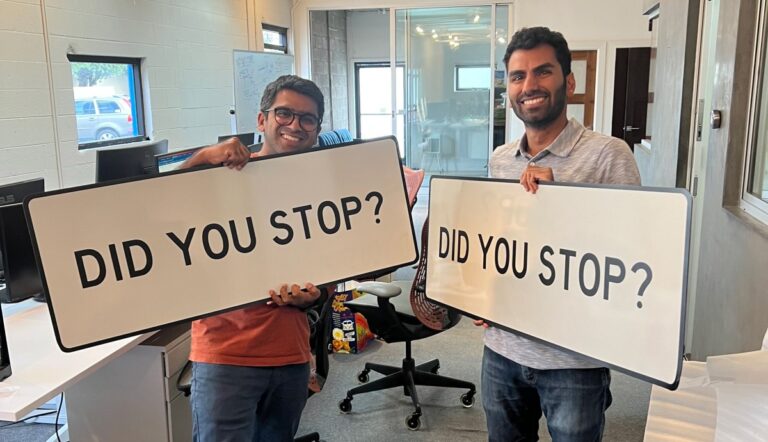
    American streets are incredibly dangerous for pedestrians. A San Carlos, California-based startup called Obvio thinks it can change that by installing cameras at stop signs — a solution the founders also say won’t create a panopticon. 

    That’s a bold claim at a time when other companies like Flock have been criticized for how its license plate-reading cameras have become a crucial tool in an overreaching surveillance state. 

    Obvio founders Ali Rehan and Dhruv Maheshwari believe they can build a big enough business without indulging those worst impulses. They’ve designed the product with surveillance and data-sharing limitations to ensure they can follow through with that claim.

    They’ve found deep pockets willing to believe them, too. The company has just completed a $22 million Series A funding round led by Bain Capital Ventures. Obvio plans to use those funds to expand beyond the first five cities where it’s currently operating in Maryland. 

    Rehan and Maheshwari met while working at Motive, a company that makes dashboard cameras for the trucking industry. While there, Maheshwari told TechCrunch the pair realized “a lot of other normal passenger vehicles are awful drivers.” 

    The founders said they were stunned the more they looked into road safety. Not only were streets and crosswalks getting more dangerous for pedestrians, but in their eyes, the U.S. was also falling behind on enforcement. 

    [embedded content]

    “Most other countries are actually pretty good at this,” Maheshwari said. “They have speed camera technology. They have a good culture of driving safety. The U.S. is actually one of the worst across all the modern nations.”

    Maheshwari and Rehan began studying up on road safety by reading books and attending conferences. They found that people in the industry gravitated toward three general solutions: education, engineering, and enforcement. 

    In their eyes, those approaches were often too separated from each other. It’s hard to quantify the impact of educational efforts. Local officials may try to fix a problematic intersection by, say, installing a roundabout, but that can take years of work and millions of dollars. And law enforcement can’t camp out at every stop sign.

    Rehan and Maheshwari saw promise in combining them. 

    The result is a pylon (often brightly-colored) topped with a solar-powered camera that can be installed near almost any intersection. It’s designed not to blend in — part of the education and awareness aspect — and it’s also carefully engineered to be cheap and easy to install.

    The on-device AI is trained to spot the worst types of stop sign or other infractions. (The company also claims on its website it can catch speeding, crosswalk violations, illegal turns, unsafe lane changes, and even distracted driving.) When one of these things happen, the system matches a car’s license plate to the state’s DMV database. 

    All of that information — the accuracy of the violation, the license plate — is verified by either Obvio staff or contractors before it’s sent to law enforcement, which then has to review the infractions before issuing a citation.

    Obvio gives the tech to municipalities for free and makes money from the citations. Exactly how that citation revenue will get split between Obvio and the governments will vary from place to place, as Maheshwari said regulations about such agreements differ by state.

    That clearly creates an incentive for increasing the number of citations. But Rehan and Maheshwari said they can build a business around stopping the worst offenses across a wide swath of American cities. They also said they want Obvio to remain present in — and responsive to — the communities that use their tech.

    “Automated enforcement should be used in conjunction with community advocacy and community support, it shouldn’t be this camera that you put up that does revenue grab[s] and gotchas,” Maheshwari said. The goal is to “start using these cameras in a way to warn and deter the most egregious drivers [so] you can actually create communitywide support and behavior change.”

    Cities and their citizens “need to trust us,” Maheshwari said. 

    There’s also a technological explanation for why Obvio’s cameras may not become an overpowered surveillance tool for law enforcement beyond their intended use.

    Obvio’s camera pylon records and processes its footage locally. It’s only when a violation is spotted that the footage leaves the device. Otherwise, all other footage of vehicles and pedestrians passing through a given intersection stays on the device for about 12 hours before it gets deleted. (The footage is also technically owned by the municipalities, which have remote access.)

    This doesn’t eliminate the chance that law enforcement will use the footage to surveil citizens in other ways. But it does reduce that chance.

    That focus is what drove Bain Capital Ventures partner Ajay Agarwal to invest in Obvio.

    “Yes, in the short term, you can maximize profits, and erode those values, but I think over time, it will limit the ability of this company to be ubiquitous. It’ll create enemies or create people who don’t want this,” he told TechCrunch. “Great founders are willing to sacrifice entire lines of business, frankly, and lots of revenue, in pursuit of the ultimate mission.”

  • RealSense spins out of Intel to scale its stereoscopic imaging technology

    After 14 years of developing inside of semiconductor giant Intel, RealSense is striking out on its own.

    RealSense sells cameras that use stereoscopic imaging, a process that combines two images of the same object from different angles to create depth, enhanced with infrared light. This technology helps machines like robots, drones, and autonomous vehicles have a better perception of the physical world around them. The tech is also used for facial authentication.

    “The common denominator of all of them is they live in the real, physical world,” CEO Nadav Orbach told TechCrunch. “They need to understand the surroundings in 3D and based on that, take and plan actions right in the world. And for that, they need a real-time, high-accuracy ability to understand the surrounding in 3D. And that’s what we do best.”

    Orbach joined Intel back in 2006 as a CPU architect in Israel. He started working on vision technology in 2011 before becoming the general manager of incubation and disruptive innovation in 2022 and moving to San Francisco last year.

    “We knew and understood that 3D perception was going to be big,” Orbach said about the early days of RealSense. “To be honest, we weren’t quite sure in which domain. We tried that across different market segments and different applications, all the way from gesture recognition with computers, phones, until we really found our sweet spot over the years, mostly in robotics.”

    The company works with numerous industries outside of robotics, too. Orbach said they’ve heard from fish farms looking to track the volume inside their pens. Chipotle has also used RealSense cameras, in a partnership with AI restaurant software company PreciTaste, to track when food containers are low.

    RealSense has more than 3,000 customers and has seen a surge in new interest over the last three to four years as AI has improved. With that, the applications for robotics, especially, have scaled.

    Techcrunch event

    Boston, MA
    |
    July 15

    The company realized it may have a better chance keeping up with demand — and scaling itself — if it spun out of Intel and raised its own capital, Orbach said.

    The spinout plans hatched last year and got the approval from former Intel CEO Pat Gelsinger. The company is now independent and raised a $50 million Series A funding round from Intel Capital and other strategic investors to get started on its own.

    “For me, it was exciting, to be honest,” Orbach said. “I’m a veteran executive in the company, but it’s first time that I’m, you know, I was on the other side of the table. It was a very humbling experience for me as a first-time CEO to go and and raise money.”

    RealSense will put the capital toward building out its go-to-market team and making improvements to its technology. The company is particularly focused on improving the tech so it can help improve safety during humans and robot interactions and to improve access control.

    “There is a learning curve of, you know, stepping out,” Orbach said. “I’m extremely excited about that. I’m fortunate to have a very strong team with a lot of people in my team that that have entrepreneurial experience. I feel that with my background, together with with some strong teammates, I think we have the right mix for success. And for me, it’s a dream coming true.”

  • Gridcare thinks more than 100 GW of data center capacity is hiding in the grid

    Hyperscalers and data center developers are in a pickle: They all want to add computing power tomorrow, but utilities frequently play hard to get, citing years-long waits for grid connections.

    “All the AI data centers are struggling to get connected,” Amit Narayan, founder and CEO of Gridcare, told TechCrunch. “They’re so desperate. They are looking for solutions, which may or may not happen. Certainly not in the five-year timelines they cite.”

    That has led many data centers to pursue what’s called “behind the meter” power sources — basically, they build their own power plants, a costly endeavor that hints at just how desperate they are for electricity.

    But Narayan knew there was plenty of slack in the system, even if utilities themselves haven’t discovered it yet. He has studied the grid for the last 15 years, first as a Stanford researcher then as a founder of another company. “How do we create more capacity when everyone thinks that there is no capacity on the grid?” he said.

    Narayan said that Gridcare, which has been operating in stealth, has already discovered several places where extra capacity exists, and it’s ready to play matchmaker between data centers and utilities.

    Gridcare recently closed an oversubscribed $13.5 million seed round, the company told TechCrunch. The round was led by Xora, Temasek’s deep tech venture firm, with participation from Acclimate Ventures, Aina Climate AI Ventures, Breakthrough Energy Discovery, Clearvision, Clocktower Ventures, Overture Ventures, Sherpalo Ventures, and WovenEarth.

    For Narayan and his colleagues at Gridcare, the first step to finding untapped capacity was to map the existing grid. Then the company used generative AI to help forecast what changes might be implemented in the coming years. It also layers on other details, including the availability of fiber optic connections, natural gas, water, extreme weather, permitting, and community sentiment around data center construction and expansion. 

    Techcrunch event

    San Francisco
    |
    October 27-29, 2025

    “There are 200,000-plus scenarios that you have to consider every time you’re running this study,” Narayan said.

    To make sure it’s not running afoul of regulations, Gridcare then takes that data and weighs it against federal guidelines that dictate grid usage. Once it finds a spot, it starts talking with the relevant utility to verify the data.

    “We’ll find out where the maximum bang for the buck is,” Narayan said.

    At the same time, Gridcare works with hyperscalers and data center developers to identify where they are looking to expand operations or build new ones. “They have already told us what they’re willing to do. We know the parameters under which they can operate,” he said.

    That’s when the matchmaking begins.

    Gridcare sells its services to data center developers, charging them a fee based on how many megawatts of capacity the startup can unlock for them. “That fee is significant for us, but it’s negligible for data centers,” Narayan said.

    For some data centers, the price of admission might be forgoing grid power for a few hours here and there, relying on on-site backup power instead. For others, the path might be clearer if their demand helps green-light a new grid-scale battery installation nearby. In the future, the winner might be the developer that is willing to pay more. Utilities have already approached Gridcare inquiring about auctioning access to newfound capacity.

    Regardless of how it happens, Narayan thinks that Gridcare can unlock more than 100 gigawatts of capacity using its approach. “We don’t have to solve nuclear fusion to do this,” he said.

    Update: Corrected spare capacity on the grid to gigawatts from megawatts.

  • Razer Pro Click V2 Vertical Review: A Hybrid Gaming Mouse

    Switching to a vertical mouse is a hard sell. Having to change how you use a mouse completely can be an intimidating task, especially with how unnatural the new hand position feels at first—you’re going entirely against the muscle memory you’ve spent years building up.One of the largest challenges to the switch is the initial loss of pointer accuracy. If you’re in an office setting, you may find yourself wandering around a bit or struggling to move your new mouse as quickly as you did before. But in a slow-paced setting like that, all you struggle with is a few mis-clicks or slightly slower navigation. If you try to make this transition with gaming, it’s far more jarring, and the consequences are much more immediately noticeable.But even if it’s difficult to adapt to, could vertical mice be the future of gaming? Razer’s new Pro Click V2 Vertical Edition is a hybrid productivity and gaming vertical mouse. Vertical mice typically cater to office workers, but the focus on gaming performance makes the $120 Pro Click V2 one of a kind.Desk PresenceThe Pro Click V2 Vertical looks, more than anything else, like a modern gaming mouse. It has the textured exterior, metallic highlights, and slightly organic, H.R. Giger-esque curvature typical of Razer’s design language. But everything has been shifted around. The curved, cutting thumb rest sits on top of the mouse instead of on the side. A flare juts out from the right side as a place to rest the underside of your hand. The gunmetal highlight sits at the peak of the mouse rather than between the two buttons. Even the USB port is vertical, a humorous attention to detail.It’s intentionally designed as a gaming mouse that just happens to be vertical. Aesthetically, the only downside is the minimal RGB lighting. With only one section of lighting that runs along the bottom of the mouse, RGB lighting fans might feel disappointed. Still, it’s bright, reactive, and has great color accuracy. It’s more than enough for me, especially with how customizable it is with Razer’s Chroma software.The Pro Click V2 Vertical has the same specs as the standard Pro Click V2, with a 1,000-Hz polling rate, a 2.4-GHz dongle that can be stored on the underside, Bluetooth multi-device connectivity, and a reprogrammable button on top. The only features lost are the mouse wheel’s horizontal scrolling and toggleable non-ratcheted rotation.This mouse includes two major productivity features: app-specific profiles and multi-device connectivity, and both work effortlessly. Razer Synapse immediately detected different software and changed the active profile in response, and pressing the button on the underside of the mouse swapped between paired devices instantaneously.Beyond that, Razer Synapse is as impressive as always. I consistently find the software to be one of the best and most intuitive on the market, and that’s the case here. All of the menus are simple and efficient, the settings can be changed in real time, and the adjustments all have tooltips and explanations to tell you exactly what you’re changing.Annoyingly, Razer Synapse has advertisements on the homepage, something I’ve complained about when reviewing SteelSeries products in the past. However, unlike Steelseries GG, these “recommendations” can be permanently disabled in the app’s settings.Performance and PracticeThe overall hand position of the Pro Click V2 Vertical is natural, but incredibly upright. While some vertical mice, like those from Logitech or Hansker, find a middle ground between a standard and truly “vertical” hand position, Razer opted for a nearly perpendicular shape. While this is technically an ideal ergonomic shape, it will be harder to adapt if you’re moving directly from a standard mouse, and might not be as comfortable during the adjustment period.It felt unnatural for the first week or so, and required practice to use comfortably and confidently. Once I had acclimated, my speed and accuracy were nearly at the same level as a standard mouse, although consistent use still felt clunky and unfamiliar compared to the horizontal mice I’d been using for most of my life.

  • Best Noise-Canceling Headphones: Sony, Bose, Apple, and More

    Honorable MentionsNow that the majority of new headphones and earbuds offer at least a modicum of noise canceling, it’d be impossible (and unproductive) to list everything we like above. If you haven’t yet found your fit, here are more favorites worth considering.Beyerdynamic Amiron 300 for $280: These simple-looking earbuds (8/10, WIRED Recommends) are a great way to experience quiet luxury. They have 10 hours of battery life with noise canceling engaged, and they have some of the best-sounding drivers for vocals I’ve heard in any earbuds.Sony WF-1000XM5 earbuds for $298: Sony’s fifth-generation flagship earbuds (7/10, WIRED Recommends) slim down while stepping up. These buds are smaller and slicker (maybe too slick when it comes to grabbing them) than the previous XM4 buds. As before, they provide great sound and noise canceling that outduels plenty of options, with a cost to match. In true Sony style, they serve up a truckload of adaptive features and EQ controls while retaining a solid eight hours of playback time per charge with ANC and 12 hours without it. —Ryan WaniataSoundcore Life Q30 for $60-85: Anker’s Soundcore line is nothing if not value-conscious, and the Life Q30 provide an embarrassing list of extras for their bargain-basement pricing. You’ll get clear and warm sound, great features, tons of battery life, and noise canceling that gets the job done even on a long flight, though it can’t keep up with flagship pairs. It’s hard to complain when they cost hundreds less, especially with sale pricing that sometimes drops to around $50.Sony WH-1000XM4 for $250-350: Sony’s WH-1000X lineup has produced some of the best noise-canceling headphones for nearly a decade, and the aging WH-1000XM4 (9/10, WIRED Recommends) are no exception. They periodically go on sale for under $300, but it’s getting harder to find them below full price, which is tough for a five-year-old model.Bowers & Wilkins Pi8 Earbuds for $400: Bowers & Wilkins’ Pi8 (8/10, WIRED Recommends) offer a sleek, comfortable design, solid (albeit not Bose-beating) noise canceling, and great sound. Call quality is also excellent, which makes these perhaps the perfect business-class earbuds, though their hefty price won’t appeal to everyone.Bowers and Wilkins PX7 S2e for $400: The Px7 S2e feature upgraded audio quality for fantastic sound in stylish and sophisticated design. They’re also among the most comfortable headphones we’ve tested, but their noise canceling doesn’t rise to the level of the top players for the money.Beyerdynamic Aventho 300 for $400: These over-ears from Beyerdynamic (7/10, WIRED Recommends) have the brand’s classic studio sound, with a tight crisp high range and punchy lows. The downside is that they don’t cancel noise quite as well as models from Sony, Bose, and others above. Still, they sound great and are worth considering, especially if you can snag them on sale.Soundcore Space A40 for $60: Another top value buy from Anker’s Soundcore brand, the Space A40 (8/10, WIRED Recommends) are some of our favorite cheap earbuds, especially as their price continues to fall. You’ll find a classy design, lots of features, quality sound, and great noise canceling for their class.Apple Beats Fit Pro for $199: The Beats Fit Pro are an aging but still knockout pair of wireless buds, with great sound, easy-access physical buttons, and solid noise canceling to boot. Add to that six hours of battery life, spatial audio compatibility with Apple Music and other services, and you’ve got one of the best pairs of earbuds ever “designed in California.”Epos/Sennheiser Adapt 660 for $210: Want excellent sound, a comfortable fit, and high-quality noise-canceling tech for less than what you’d pay for Sony or Bose headphones? Check out this collaboration between Epos and Sennheiser. The Epos/Sennheiser Adapt 660 (8/10, WIRED Recommends) sound fantastic and are some of the lightest noise-canceling headphones I’ve ever worn. They also feature excellent microphones for great silence on calls and Zooms.

Leave a Reply

Your email address will not be published. Required fields are marked *