Obvio’s stop sign cameras use AI to root out unsafe drivers
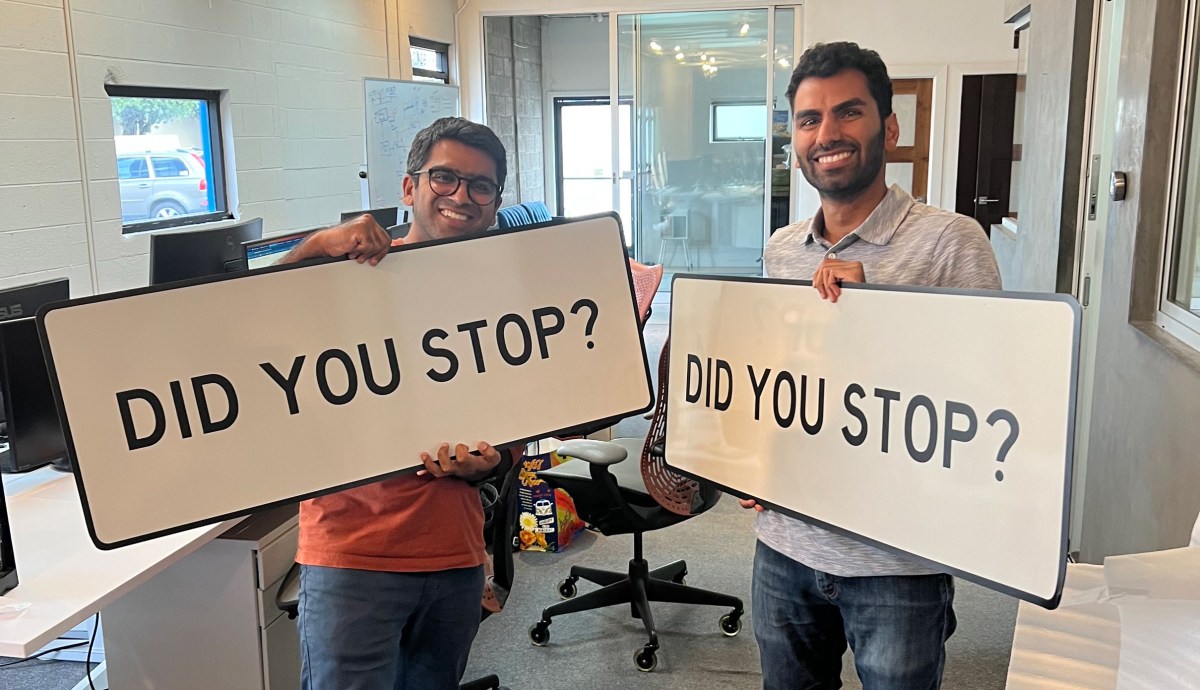
American streets are incredibly dangerous for pedestrians. A San Carlos, California-based startup called Obvio thinks it can change that by installing cameras at stop signs — a solution the founders also say won’t create a panopticon. 

That’s a bold claim at a time when other companies like Flock have been criticized for how its license plate-reading cameras have become a crucial tool in an overreaching surveillance state

Obvio founders Ali Rehan and Dhruv Maheshwari believe they can build a big enough business without indulging those worst impulses. They’ve designed the product with surveillance and data-sharing limitations to ensure they can follow through with that claim.

They’ve found deep pockets willing to believe them, too. The company has just completed a $22 million Series A funding round led by Bain Capital Ventures. Obvio plans to use those funds to expand beyond the first five cities where it’s currently operating in Maryland. 

Rehan and Maheshwari met while working at Motive, a company that makes dashboard cameras for the trucking industry. While there, Maheshwari told TechCrunch the pair realized “a lot of other normal passenger vehicles are awful drivers.” 

The founders said they were stunned the more they looked into road safety. Not only were streets and crosswalks getting more dangerous for pedestrians, but in their eyes, the U.S. was also falling behind on enforcement. 

“Most other countries are actually pretty good at this,” Maheshwari said. “They have speed camera technology. They have a good culture of driving safety. The U.S. is actually one of the worst across all the modern nations.”

Maheshwari and Rehan began studying up on road safety by reading books and attending conferences. They found that people in the industry gravitated toward three general solutions: education, engineering, and enforcement. 

In their eyes, those approaches were often too separated from each other. It’s hard to quantify the impact of educational efforts. Local officials may try to fix a problematic intersection by, say, installing a roundabout, but that can take years of work and millions of dollars. And law enforcement can’t camp out at every stop sign.

Rehan and Maheshwari saw promise in combining them. 

The result is a pylon (often brightly-colored) topped with a solar-powered camera that can be installed near almost any intersection. It’s designed not to blend in — part of the education and awareness aspect — and it’s also carefully engineered to be cheap and easy to install.

The on-device AI is trained to spot the worst types of stop sign or other infractions. (The company also claims on its website it can catch speeding, crosswalk violations, illegal turns, unsafe lane changes, and even distracted driving.) When one of these things happen, the system matches a car’s license plate to the state’s DMV database. 

All of that information — the accuracy of the violation, the license plate — is verified by either Obvio staff or contractors before it’s sent to law enforcement, which then has to review the infractions before issuing a citation.

Obvio gives the tech to municipalities for free and makes money from the citations. Exactly how that citation revenue will get split between Obvio and the governments will vary from place to place, as Maheshwari said regulations about such agreements differ by state.

That clearly creates an incentive for increasing the number of citations. But Rehan and Maheshwari said they can build a business around stopping the worst offenses across a wide swath of American cities. They also said they want Obvio to remain present in — and responsive to — the communities that use their tech.

“Automated enforcement should be used in conjunction with community advocacy and community support, it shouldn’t be this camera that you put up that does revenue grab[s] and gotchas,” Maheshwari said. The goal is to “start using these cameras in a way to warn and deter the most egregious drivers [so] you can actually create communitywide support and behavior change.”

Cities and their citizens “need to trust us,” Maheshwari said. 

There’s also a technological explanation for why Obvio’s cameras may not become an overpowered surveillance tool for law enforcement beyond their intended use.

Obvio’s camera pylon records and processes its footage locally. It’s only when a violation is spotted that the footage leaves the device. Otherwise, all other footage of vehicles and pedestrians passing through a given intersection stays on the device for about 12 hours before it gets deleted. (The footage is also technically owned by the municipalities, which have remote access.)

This doesn’t eliminate the chance that law enforcement will use the footage to surveil citizens in other ways. But it does reduce that chance.

That focus is what drove Bain Capital Ventures partner Ajay Agarwal to invest in Obvio.

“Yes, in the short term, you can maximize profits, and erode those values, but I think over time, it will limit the ability of this company to be ubiquitous. It’ll create enemies or create people who don’t want this,” he told TechCrunch. “Great founders are willing to sacrifice entire lines of business, frankly, and lots of revenue, in pursuit of the ultimate mission.”


Similar Posts

  • Razer Pro Click V2 Vertical Review: A Hybrid Gaming Mouse

    Switching to a vertical mouse is a hard sell. Having to change how you use a mouse completely can be an intimidating task, especially with how unnatural the new hand position feels at first—you’re going entirely against the muscle memory you’ve spent years building up.One of the largest challenges to the switch is the initial loss of pointer accuracy. If you’re in an office setting, you may find yourself wandering around a bit or struggling to move your new mouse as quickly as you did before. But in a slow-paced setting like that, all you struggle with is a few mis-clicks or slightly slower navigation. If you try to make this transition with gaming, it’s far more jarring, and the consequences are much more immediately noticeable.But even if it’s difficult to adapt to, could vertical mice be the future of gaming? Razer’s new Pro Click V2 Vertical Edition is a hybrid productivity and gaming vertical mouse. Vertical mice typically cater to office workers, but the focus on gaming performance makes the $120 Pro Click V2 one of a kind.Desk PresenceThe Pro Click V2 Vertical looks, more than anything else, like a modern gaming mouse. It has the textured exterior, metallic highlights, and slightly organic, H.R. Giger-esque curvature typical of Razer’s design language. But everything has been shifted around. The curved, cutting thumb rest sits on top of the mouse instead of on the side. A flare juts out from the right side as a place to rest the underside of your hand. The gunmetal highlight sits at the peak of the mouse rather than between the two buttons. Even the USB port is vertical, a humorous attention to detail.It’s intentionally designed as a gaming mouse that just happens to be vertical. Aesthetically, the only downside is the minimal RGB lighting. With only one section of lighting that runs along the bottom of the mouse, RGB lighting fans might feel disappointed. Still, it’s bright, reactive, and has great color accuracy. It’s more than enough for me, especially with how customizable it is with Razer’s Chroma software.The Pro Click V2 Vertical has the same specs as the standard Pro Click V2, with a 1,000-Hz polling rate, a 2.4-GHz dongle that can be stored on the underside, Bluetooth multi-device connectivity, and a reprogrammable button on top. The only features lost are the mouse wheel’s horizontal scrolling and toggleable non-ratcheted rotation.This mouse includes two major productivity features: app-specific profiles and multi-device connectivity, and both work effortlessly. Razer Synapse immediately detected different software and changed the active profile in response, and pressing the button on the underside of the mouse swapped between paired devices instantaneously.Beyond that, Razer Synapse is as impressive as always. I consistently find the software to be one of the best and most intuitive on the market, and that’s the case here. All of the menus are simple and efficient, the settings can be changed in real time, and the adjustments all have tooltips and explanations to tell you exactly what you’re changing.Annoyingly, Razer Synapse has advertisements on the homepage, something I’ve complained about when reviewing SteelSeries products in the past. However, unlike Steelseries GG, these “recommendations” can be permanently disabled in the app’s settings.Performance and PracticeThe overall hand position of the Pro Click V2 Vertical is natural, but incredibly upright. While some vertical mice, like those from Logitech or Hansker, find a middle ground between a standard and truly “vertical” hand position, Razer opted for a nearly perpendicular shape. While this is technically an ideal ergonomic shape, it will be harder to adapt if you’re moving directly from a standard mouse, and might not be as comfortable during the adjustment period.It felt unnatural for the first week or so, and required practice to use comfortably and confidently. Once I had acclimated, my speed and accuracy were nearly at the same level as a standard mouse, although consistent use still felt clunky and unfamiliar compared to the horizontal mice I’d been using for most of my life.

  • Get paid faster: How Intuit’s new AI agents help businesses get funds up to 5 days faster and save 12 hours a month with autonomous workflows

    Join the event trusted by enterprise leaders for nearly two decades. VB Transform brings together the people building real enterprise AI strategy. Learn more Intuit has been on a journey over the last several years with generative AI, incorporating the technology as part of its services at QuickBooks, Credit Karma,Turbotax and Mailchimp. Today the company is…

  • Web Guide: An experimental AI-organized search results page

    We’re launching Web Guide, a Search Labs experiment that uses AI to intelligently organize the search results page, making it easier to find information and web pages.Web Guide groups web links in helpful ways — like pages related to specific aspects of your query. Under the hood, Web Guide uses a custom version of Gemini to better understand both a search query and content on the web, creating more powerful search capabilities that better surface web pages you may not have previously discovered. Similar to AI Mode, Web Guide uses a query fan-out technique, concurrently issuing multiple related searches to identify the most relevant results.For example, try it for open-ended searches like “how to solo travel in Japan.” Or try detailed queries in multiple sentences like, “My family is spread across multiple time zones. What are the best tools for staying connected and maintaining close relationships despite the distance?”

  • RealSense spins out of Intel to scale its stereoscopic imaging technology

    After 14 years of developing inside of semiconductor giant Intel, RealSense is striking out on its own.

    RealSense sells cameras that use stereoscopic imaging, a process that combines two images of the same object from different angles to create depth, enhanced with infrared light. This technology helps machines like robots, drones, and autonomous vehicles have a better perception of the physical world around them. The tech is also used for facial authentication.

    “The common denominator of all of them is they live in the real, physical world,” CEO Nadav Orbach told TechCrunch. “They need to understand the surroundings in 3D and based on that, take and plan actions right in the world. And for that, they need a real-time, high-accuracy ability to understand the surrounding in 3D. And that’s what we do best.”

    Orbach joined Intel back in 2006 as a CPU architect in Israel. He started working on vision technology in 2011 before becoming the general manager of incubation and disruptive innovation in 2022 and moving to San Francisco last year.

    “We knew and understood that 3D perception was going to be big,” Orbach said about the early days of RealSense. “To be honest, we weren’t quite sure in which domain. We tried that across different market segments and different applications, all the way from gesture recognition with computers, phones, until we really found our sweet spot over the years, mostly in robotics.”

    The company works with numerous industries outside of robotics, too. Orbach said they’ve heard from fish farms looking to track the volume inside their pens. Chipotle has also used RealSense cameras, in a partnership with AI restaurant software company PreciTaste, to track when food containers are low.

    RealSense has more than 3,000 customers and has seen a surge in new interest over the last three to four years as AI has improved. With that, the applications for robotics, especially, have scaled.

    Techcrunch event

    Boston, MA
    |
    July 15

    The company realized it may have a better chance keeping up with demand — and scaling itself — if it spun out of Intel and raised its own capital, Orbach said.

    The spinout plans hatched last year and got the approval from former Intel CEO Pat Gelsinger. The company is now independent and raised a $50 million Series A funding round from Intel Capital and other strategic investors to get started on its own.

    “For me, it was exciting, to be honest,” Orbach said. “I’m a veteran executive in the company, but it’s first time that I’m, you know, I was on the other side of the table. It was a very humbling experience for me as a first-time CEO to go and and raise money.”

    RealSense will put the capital toward building out its go-to-market team and making improvements to its technology. The company is particularly focused on improving the tech so it can help improve safety during humans and robot interactions and to improve access control.

    “There is a learning curve of, you know, stepping out,” Orbach said. “I’m extremely excited about that. I’m fortunate to have a very strong team with a lot of people in my team that that have entrepreneurial experience. I feel that with my background, together with with some strong teammates, I think we have the right mix for success. And for me, it’s a dream coming true.”

  • Google DeepMind’s new AI can help historians understand ancient Latin inscriptions

    Google DeepMind has unveiled new artificial-intelligence software that could help historians recover the meaning and context behind ancient Latin engravings.  Aeneas can analyze words written in long-weathered stone to say when and where they were originally inscribed. It follows Google’s previous archaeological tool Ithaca, which also used deep learning to reconstruct and contextualize ancient text, in its case Greek. But while Ithaca and Aeneas use some similar systems, Aeneas also promises to give researchers jumping-off points for further analysis. To do this, Aeneas takes in partial transcriptions of an inscription alongside a scanned image of it. Using these, it gives possible dates and places of origins for the engraving, along with potential fill-ins for any missing text. For example, a slab damaged at the start and continuing with … us populusque Romanus would likely prompt Aeneas to guess that Senat comes before us to create the phrase Senatus populusque Romanus, “The Senate and the people of Rome.”  This is similar to how Ithaca works. But Aeneas also cross-references the text with a stored database of almost 150,000 inscriptions, which originated everywhere from modern-day Britain to modern-day Iraq, to give possible parallels—other catalogued Latin engravings that feature similar words, phrases, and analogies. 
    This database, alongside a few thousand images of inscriptions, makes up the training set for Aeneas’s deep neural network. While it may seem like a good number of samples, it pales in comparison to the billions of documents used to train general-purpose large language models like Google’s Gemini. There simply aren’t enough high-quality scans of inscriptions to train a language model to learn this kind of task. That’s why specialized solutions like Aeneas are needed.  The Aeneas team believes it could help researchers “connect the past,” said Yannis Assael, a researcher at Google DeepMind who worked on the project. Rather than seeking to automate epigraphy—the research field dealing with deciphering and understanding inscriptions—he and his colleagues are interested in “crafting a tool that will integrate with the workflow of a historian,” Assael said in a press briefing. 
    Their goal is to give researchers trying to analyze a specific inscription many hypotheses to work from, saving them the effort of sifting through records by hand. To validate the system, the team presented 23 historians with inscriptions that had been previously dated and tested their workflows both with and without Aeneas. The findings, which were published today in Nature, showed that Aeneas helped spur research ideas among the historians for 90% of inscriptions and that it led to more accurate determinations of where and when the inscriptions originated. In addition to this study, the researchers tested Aeneas on the Monumentum Ancyranum, a famous inscription carved into the walls of a temple in Ankara, Turkey. Here, Aeneas managed to give estimates and parallels that reflected existing historical analysis of the work, and in its attention to detail, the paper claims, it closely matched how a trained historian would approach the problem. “That was jaw-dropping,” Thea Sommerschield, an epigrapher at the University of Nottingham who also worked on Aeneas, said in the press briefing.  However, much remains to be seen about Aeneas’s capabilities in the real world. It doesn’t guess the meaning of texts, so it can’t interpret newly found engravings on its own, and it’s not clear yet how useful it will be to historians’ workflows in the long term, according to Kathleen Coleman, a professor of classics at Harvard. The Monumentum Ancyranum is considered to be one of the best-known and most well-studied inscriptions in epigraphy, raising the question of how Aeneas will fare on more obscure samples.  Google DeepMind has now made Aeneas open-source, and the interface for the system is freely available for teachers, students, museum workers, and academics. The group is working with schools in Belgium to integrate Aeneas into their secondary history education.  “To have Aeneas at your side while you’re in the museum or at the archaeological site where a new inscription has just been found—that is our sort of dream scenario,” Sommerschield said.

Leave a Reply

Your email address will not be published. Required fields are marked *