The Drifter is a good old-fashioned thriller

It’s a point-and-click adventure that tells a twisting mystery.

It’s a point-and-click adventure that tells a twisting mystery.
ss_4b1247bafd099f31b4182b8f68812b0c49467595
Jay Peters
Jay Peters is a news editor covering technology, gaming, and more. He joined The Verge in 2019 after nearly two years at Techmeme.

Point-and-click adventure games often tell silly, lighthearted stories. For me, the mishaps of the pirate Guybrush Threepwood in the Monkey Island series come to mind. The nature of the genre — wandering around, talking to people, and trying to solve puzzles — lends itself well to humor, as every interaction with a person or object offers an opportunity for a joke. The Drifter, a new point-and-click game from Powerhoof, cleverly uses the format to instead tell a dark, twist-filled thriller, and it sucked me in like a gripping novel.

In The Drifter, you play as Mick Carter, who you meet shortly after he hops aboard a train as a stowaway. Within moments you’ll witness a brutal, unexplained murder and be forced to go on the run, and the story quickly becomes a complex web of characters, pursuers, and mysteries to poke at.

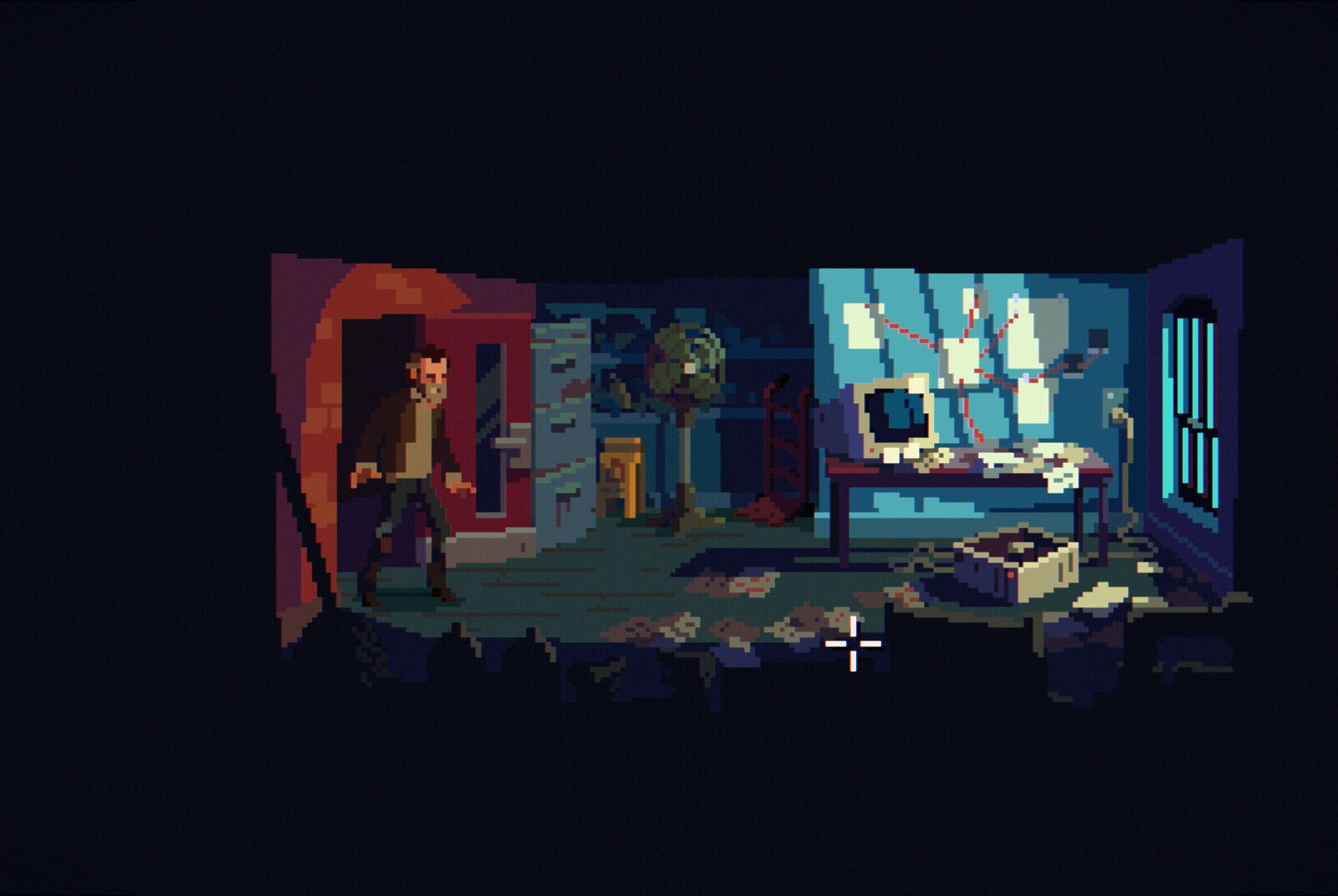
Mick serves as the game’s narrator, often describing what he’s doing in a grim, first-person tone with full voice acting by Adrian Vaughan. Mick’s tone sometimes feels a bit heavy-handed and overdramatic, but I enjoyed Vaughan’s performance anyway — it really sets a pulpy tone that’s fun to sink into. The game’s gorgeous pixel art helps, too, and locations have dramatic lighting and moody shadows.

This being a point-and-click adventure, the primary way to move the story forward is by solving puzzles, often by using the right object at the right place at the right time. The game is usually pretty good at suggesting where you need to go through conversations or through a list of broader story threads you’re investigating.

Actually doing the investigating is straightforward. I played The Drifter on Steam Deck, and it has a smart control scheme seemingly inspired by twin-stick shooters that shaves off a lot of the clunkiness of old-school LucasArts adventure games. You move Mick around with the left control stick, but when you move the right control stick, a little circle pops up around him with squares that indicate things nearby that you can interact with. You can select things you want to look at with a press of a trigger button. (You can, of course, use a more traditional mouse to play the game, too.)

More than once, though, I got completely stuck, and I often just brute-forced every item in my inventory with every person I could talk to until I found a way to move forward. I also occasionally leaned on online guides to figure out where to go next or if I missed something while investigating. When I hit walls, I really wished there was some kind of direct in-game hint system to give me a push in the right direction — this is an old-school issue with the genre, but a lot of modern games have figured it out.

Pushing through those more obtuse head-scratchers was worth it, though: in the later parts of my eight-hour run of The Drifter, the narrative threads all started to come together in some truly mind-bending ways. More than once, I stayed up way past my bedtime as I raced to figure out what would happen next.

I’m glad this story for Mick is over, but part of me hopes he runs into trouble again so I can cozy up with another point-and-click thriller.

The Drifter is available now on PC.

Follow topics and authors from this story to see more like this in your personalized homepage feed and to receive email updates.

Lewis Gordon
Jay Peters
Andrew Webster

Most Popular

Similar Posts

  • The hidden scaling cliff that’s about to break your agent rollouts

    Join the event trusted by enterprise leaders for nearly two decades. VB Transform brings together the people building real enterprise AI strategy. Learn more Enterprises that want to build and scale agents also need to embrace another reality: agents aren’t built like other software.  Agents are “categorically different” in how they’re built, how they operate, and…

  • Best Noise-Canceling Headphones: Sony, Bose, Apple, and More

    Honorable MentionsNow that the majority of new headphones and earbuds offer at least a modicum of noise canceling, it’d be impossible (and unproductive) to list everything we like above. If you haven’t yet found your fit, here are more favorites worth considering.Beyerdynamic Amiron 300 for $280: These simple-looking earbuds (8/10, WIRED Recommends) are a great way to experience quiet luxury. They have 10 hours of battery life with noise canceling engaged, and they have some of the best-sounding drivers for vocals I’ve heard in any earbuds.Sony WF-1000XM5 earbuds for $298: Sony’s fifth-generation flagship earbuds (7/10, WIRED Recommends) slim down while stepping up. These buds are smaller and slicker (maybe too slick when it comes to grabbing them) than the previous XM4 buds. As before, they provide great sound and noise canceling that outduels plenty of options, with a cost to match. In true Sony style, they serve up a truckload of adaptive features and EQ controls while retaining a solid eight hours of playback time per charge with ANC and 12 hours without it. —Ryan WaniataSoundcore Life Q30 for $60-85: Anker’s Soundcore line is nothing if not value-conscious, and the Life Q30 provide an embarrassing list of extras for their bargain-basement pricing. You’ll get clear and warm sound, great features, tons of battery life, and noise canceling that gets the job done even on a long flight, though it can’t keep up with flagship pairs. It’s hard to complain when they cost hundreds less, especially with sale pricing that sometimes drops to around $50.Sony WH-1000XM4 for $250-350: Sony’s WH-1000X lineup has produced some of the best noise-canceling headphones for nearly a decade, and the aging WH-1000XM4 (9/10, WIRED Recommends) are no exception. They periodically go on sale for under $300, but it’s getting harder to find them below full price, which is tough for a five-year-old model.Bowers & Wilkins Pi8 Earbuds for $400: Bowers & Wilkins’ Pi8 (8/10, WIRED Recommends) offer a sleek, comfortable design, solid (albeit not Bose-beating) noise canceling, and great sound. Call quality is also excellent, which makes these perhaps the perfect business-class earbuds, though their hefty price won’t appeal to everyone.Bowers and Wilkins PX7 S2e for $400: The Px7 S2e feature upgraded audio quality for fantastic sound in stylish and sophisticated design. They’re also among the most comfortable headphones we’ve tested, but their noise canceling doesn’t rise to the level of the top players for the money.Beyerdynamic Aventho 300 for $400: These over-ears from Beyerdynamic (7/10, WIRED Recommends) have the brand’s classic studio sound, with a tight crisp high range and punchy lows. The downside is that they don’t cancel noise quite as well as models from Sony, Bose, and others above. Still, they sound great and are worth considering, especially if you can snag them on sale.Soundcore Space A40 for $60: Another top value buy from Anker’s Soundcore brand, the Space A40 (8/10, WIRED Recommends) are some of our favorite cheap earbuds, especially as their price continues to fall. You’ll find a classy design, lots of features, quality sound, and great noise canceling for their class.Apple Beats Fit Pro for $199: The Beats Fit Pro are an aging but still knockout pair of wireless buds, with great sound, easy-access physical buttons, and solid noise canceling to boot. Add to that six hours of battery life, spatial audio compatibility with Apple Music and other services, and you’ve got one of the best pairs of earbuds ever “designed in California.”Epos/Sennheiser Adapt 660 for $210: Want excellent sound, a comfortable fit, and high-quality noise-canceling tech for less than what you’d pay for Sony or Bose headphones? Check out this collaboration between Epos and Sennheiser. The Epos/Sennheiser Adapt 660 (8/10, WIRED Recommends) sound fantastic and are some of the lightest noise-canceling headphones I’ve ever worn. They also feature excellent microphones for great silence on calls and Zooms.

  • Obvio’s stop sign cameras use AI to root out unsafe drivers

    American streets are incredibly dangerous for pedestrians. A San Carlos, California-based startup called Obvio thinks it can change that by installing cameras at stop signs — a solution the founders also say won’t create a panopticon. 

    That’s a bold claim at a time when other companies like Flock have been criticized for how its license plate-reading cameras have become a crucial tool in an overreaching surveillance state. 

    Obvio founders Ali Rehan and Dhruv Maheshwari believe they can build a big enough business without indulging those worst impulses. They’ve designed the product with surveillance and data-sharing limitations to ensure they can follow through with that claim.

    They’ve found deep pockets willing to believe them, too. The company has just completed a $22 million Series A funding round led by Bain Capital Ventures. Obvio plans to use those funds to expand beyond the first five cities where it’s currently operating in Maryland. 

    Rehan and Maheshwari met while working at Motive, a company that makes dashboard cameras for the trucking industry. While there, Maheshwari told TechCrunch the pair realized “a lot of other normal passenger vehicles are awful drivers.” 

    The founders said they were stunned the more they looked into road safety. Not only were streets and crosswalks getting more dangerous for pedestrians, but in their eyes, the U.S. was also falling behind on enforcement. 

    [embedded content]

    “Most other countries are actually pretty good at this,” Maheshwari said. “They have speed camera technology. They have a good culture of driving safety. The U.S. is actually one of the worst across all the modern nations.”

    Maheshwari and Rehan began studying up on road safety by reading books and attending conferences. They found that people in the industry gravitated toward three general solutions: education, engineering, and enforcement. 

    In their eyes, those approaches were often too separated from each other. It’s hard to quantify the impact of educational efforts. Local officials may try to fix a problematic intersection by, say, installing a roundabout, but that can take years of work and millions of dollars. And law enforcement can’t camp out at every stop sign.

    Rehan and Maheshwari saw promise in combining them. 

    The result is a pylon (often brightly-colored) topped with a solar-powered camera that can be installed near almost any intersection. It’s designed not to blend in — part of the education and awareness aspect — and it’s also carefully engineered to be cheap and easy to install.

    The on-device AI is trained to spot the worst types of stop sign or other infractions. (The company also claims on its website it can catch speeding, crosswalk violations, illegal turns, unsafe lane changes, and even distracted driving.) When one of these things happen, the system matches a car’s license plate to the state’s DMV database. 

    All of that information — the accuracy of the violation, the license plate — is verified by either Obvio staff or contractors before it’s sent to law enforcement, which then has to review the infractions before issuing a citation.

    Obvio gives the tech to municipalities for free and makes money from the citations. Exactly how that citation revenue will get split between Obvio and the governments will vary from place to place, as Maheshwari said regulations about such agreements differ by state.

    That clearly creates an incentive for increasing the number of citations. But Rehan and Maheshwari said they can build a business around stopping the worst offenses across a wide swath of American cities. They also said they want Obvio to remain present in — and responsive to — the communities that use their tech.

    “Automated enforcement should be used in conjunction with community advocacy and community support, it shouldn’t be this camera that you put up that does revenue grab[s] and gotchas,” Maheshwari said. The goal is to “start using these cameras in a way to warn and deter the most egregious drivers [so] you can actually create communitywide support and behavior change.”

    Cities and their citizens “need to trust us,” Maheshwari said. 

    There’s also a technological explanation for why Obvio’s cameras may not become an overpowered surveillance tool for law enforcement beyond their intended use.

    Obvio’s camera pylon records and processes its footage locally. It’s only when a violation is spotted that the footage leaves the device. Otherwise, all other footage of vehicles and pedestrians passing through a given intersection stays on the device for about 12 hours before it gets deleted. (The footage is also technically owned by the municipalities, which have remote access.)

    This doesn’t eliminate the chance that law enforcement will use the footage to surveil citizens in other ways. But it does reduce that chance.

    That focus is what drove Bain Capital Ventures partner Ajay Agarwal to invest in Obvio.

    “Yes, in the short term, you can maximize profits, and erode those values, but I think over time, it will limit the ability of this company to be ubiquitous. It’ll create enemies or create people who don’t want this,” he told TechCrunch. “Great founders are willing to sacrifice entire lines of business, frankly, and lots of revenue, in pursuit of the ultimate mission.”

  • Google DeepMind’s new AI can help historians understand ancient Latin inscriptions

    Google DeepMind has unveiled new artificial-intelligence software that could help historians recover the meaning and context behind ancient Latin engravings.  Aeneas can analyze words written in long-weathered stone to say when and where they were originally inscribed. It follows Google’s previous archaeological tool Ithaca, which also used deep learning to reconstruct and contextualize ancient text, in its case Greek. But while Ithaca and Aeneas use some similar systems, Aeneas also promises to give researchers jumping-off points for further analysis. To do this, Aeneas takes in partial transcriptions of an inscription alongside a scanned image of it. Using these, it gives possible dates and places of origins for the engraving, along with potential fill-ins for any missing text. For example, a slab damaged at the start and continuing with … us populusque Romanus would likely prompt Aeneas to guess that Senat comes before us to create the phrase Senatus populusque Romanus, “The Senate and the people of Rome.”  This is similar to how Ithaca works. But Aeneas also cross-references the text with a stored database of almost 150,000 inscriptions, which originated everywhere from modern-day Britain to modern-day Iraq, to give possible parallels—other catalogued Latin engravings that feature similar words, phrases, and analogies. 
    This database, alongside a few thousand images of inscriptions, makes up the training set for Aeneas’s deep neural network. While it may seem like a good number of samples, it pales in comparison to the billions of documents used to train general-purpose large language models like Google’s Gemini. There simply aren’t enough high-quality scans of inscriptions to train a language model to learn this kind of task. That’s why specialized solutions like Aeneas are needed.  The Aeneas team believes it could help researchers “connect the past,” said Yannis Assael, a researcher at Google DeepMind who worked on the project. Rather than seeking to automate epigraphy—the research field dealing with deciphering and understanding inscriptions—he and his colleagues are interested in “crafting a tool that will integrate with the workflow of a historian,” Assael said in a press briefing. 
    Their goal is to give researchers trying to analyze a specific inscription many hypotheses to work from, saving them the effort of sifting through records by hand. To validate the system, the team presented 23 historians with inscriptions that had been previously dated and tested their workflows both with and without Aeneas. The findings, which were published today in Nature, showed that Aeneas helped spur research ideas among the historians for 90% of inscriptions and that it led to more accurate determinations of where and when the inscriptions originated. In addition to this study, the researchers tested Aeneas on the Monumentum Ancyranum, a famous inscription carved into the walls of a temple in Ankara, Turkey. Here, Aeneas managed to give estimates and parallels that reflected existing historical analysis of the work, and in its attention to detail, the paper claims, it closely matched how a trained historian would approach the problem. “That was jaw-dropping,” Thea Sommerschield, an epigrapher at the University of Nottingham who also worked on Aeneas, said in the press briefing.  However, much remains to be seen about Aeneas’s capabilities in the real world. It doesn’t guess the meaning of texts, so it can’t interpret newly found engravings on its own, and it’s not clear yet how useful it will be to historians’ workflows in the long term, according to Kathleen Coleman, a professor of classics at Harvard. The Monumentum Ancyranum is considered to be one of the best-known and most well-studied inscriptions in epigraphy, raising the question of how Aeneas will fare on more obscure samples.  Google DeepMind has now made Aeneas open-source, and the interface for the system is freely available for teachers, students, museum workers, and academics. The group is working with schools in Belgium to integrate Aeneas into their secondary history education.  “To have Aeneas at your side while you’re in the museum or at the archaeological site where a new inscription has just been found—that is our sort of dream scenario,” Sommerschield said.

Leave a Reply

Your email address will not be published. Required fields are marked *